Access your Back Office at your fingertips.
Download the app now on Google Play Store.
Scan the QR code
You can also scan QR code with your phone to download the app.
Does Lendsqr offer API services?
Updated
On this page
APIs can significantly boost your lending app by connecting it to external services like credit bureaus, identity verification, and fraud detection systems. For example, your app can use an API to instantly check if a borrower has defaulted on loans, appears on credit bureau blacklists, or has a fraud history. Instead of waiting hours or days for manual reviews, your system verifies these details in real time during the application. This way, you reduce risk, approve loans faster, and lend only to trustworthy customers.
Lendsqr offers these capabilities through our Adjutor API services, which provide tools for credit checks, blacklist screening, income estimation, and more, all designed to help lenders make faster, safer decisions. You can sign up and start using the API service at https://adjutor.io
Understanding APIs and their role in modern lending
Application Programming Interfaces, or APIs, serve as connectors that allow different software systems to communicate and share data automatically. In lending operations, APIs eliminate the need for manual data entry, phone calls to verify information, or waiting days for third parties to respond to requests. Instead, your lending platform sends a request to an external system through an API, receives an instant response, and uses that information to make decisions within seconds.
Traditional lending processes involve significant manual work and waiting periods. A borrower applies for a loan, and the lender must manually verify their identity by inspecting documents, check their credit history by requesting reports from credit bureaus and waiting for delivery, confirm their employment by calling employers or requesting payslips, and assess fraud risk by reviewing application details for inconsistencies. Each of these steps takes time, creates opportunities for human error, and delays the borrower’s experience.
APIs transform this process by automating verification and data gathering. When a borrower submits an application, your system automatically sends API requests to identity verification services that confirm the borrower’s details match official records, credit bureaus that return credit scores and payment histories instantly, employment verification services that confirm job status and income, fraud detection systems that analyze application patterns and flag suspicious behavior, and blacklist databases that identify known defaulters or fraudsters.
All of these checks happen in parallel within seconds, allowing your system to make approval decisions while the borrower waits rather than making them wait days for manual review processes to complete. This speed improves customer satisfaction, increases conversion rates, and allows you to process far more loan applications with the same staff resources.
What Adjutor provides to lenders
Adjutor, derived from the Latin word “helper,” is Lendsqr’s comprehensive API platform designed specifically for lenders and fintech companies. It focuses on offering credit decision and KYC validation APIs to aid lenders in making informed decisions. Adjutor was developed to help lenders and fintechs, especially those who have built their own tech stacks, to enjoy the data ecosystem and superior API services provided by Lendsqr.
The platform addresses a critical challenge in the Nigerian and African lending markets. While data and algorithms are essential for smart lending decisions, getting access to good quality and cost-effective data with affordable API services has historically been almost impossible. Adjutor solves this by aggregating integrations with credit bureaus, identity verification providers, and fraud detection systems, offering them through a single platform at significantly lower costs than accessing these services individually.
Adjutor provides APIs across several critical categories that cover the full spectrum of lending verification and decision-making needs.
Validation APIs
Validation APIs allow you to confirm certain details that your customers have provided. Using validation APIs, you can confirm the authenticity of the customers on your platform. Key validation capabilities include BVN image matching, where you confirm customer identities by comparing their profile image against the image from their Bank Verification Number. This filters through potential fraudsters who may be impersonating others.
Bank account verification allows you to verify the account information customers submit by running name enquiry checks on accounts and confirming their validity. You can cross-reference the BVN linked to the account number against the BVN submitted by the customer for additional verification.
Karma lookup is one of Adjutor’s most valuable features. Karma is one of the largest blacklists of chronic defaulters and fraudsters within the Nigerian credit space. Using identifiers like email, phone number, or BVN, you can call the endpoint to confirm whether this information exists in the database of known bad actors. This prevents customers who have been blacklisted for committing fraud or defaulting on loans across the fintech space from onboarding on your platform.
Ecosystem lookup allows you to access Adjutor’s rapidly growing ecosystem of users accumulated over time. You can tap into this data to know more about borrowers’ past performance with other lenders on the Lendsqr ecosystem, generating rich insights on a customer’s credit history.
Credit Bureau APIs
Adjutor provides integrations with Nigeria’s leading credit bureaus including FirstCentral, CRC Credit Bureau, and CreditRegistry. These Credit Bureau APIs are extensions of Lendsqr’s partnerships with these institutions, allowing you to obtain accurate credit reports and scores using BVNs.
You can determine your customer’s credit history before giving them a loan by running checks to see if a customer has a history of defaulting on loans on several platforms or if they have good credit standing. For maximum coverage, you can run checks with multiple credit bureaus in sequence, ensuring comprehensive credit assessment at costs significantly lower than accessing these bureaus individually.
Decisioning APIs
Adjutor’s decisioning APIs help you make well-informed credit decisions using Lendsqr’s decision engine. The platform offers Oraculi Borrower Scoring, a proprietary scoring model that evaluates customer creditworthiness through configurable parameters.
The service helps lenders develop or fine-tune scoring models based on a range of metrics to determine the creditworthiness of a person or business. Your scoring model is based on the Risk Assessment Criteria parameters that you define for your loan products. You assign scores to the various field options customers can provide and get a cumulative score that helps you decide if the customer is creditworthy.
Direct Debit APIs
Direct Debit APIs allow you to tokenize bank access, manage payments, and activate direct debit mandates. The powerful feature of these APIs is that you can get paid even if the borrower doesn’t have the full amount in their accounts at the time of the scheduled deduction. This significantly improves collection rates compared to requiring manual payments or one-time charges that fail when insufficient funds are available.
Also read: Integrating with Lendsqr Direct Debit APIs
Embedded Loans
Adjutor enables you to scale your business by integrating embedded loans into your app or quickly deploying scalable Buy Now, Pay Later offerings with just a few clicks. This allows businesses that are not primarily lenders to offer financing options to their customers seamlessly.
How API integration improves lending operations
Integrating Adjutor APIs into your lending workflow delivers concrete improvements across multiple operational dimensions.
Faster application processing
Manual verification processes that once took days or weeks now complete in seconds. A loan application that previously required two days for identity verification, credit checks, and employment confirmation can now be fully assessed and approved within minutes. This speed advantage is not just convenient but competitive. In markets where multiple lenders compete for the same customers, the lender who approves first often wins the business.
Reduced operational costs
APIs dramatically reduce the staff time required per loan application. Instead of loan officers spending hours making phone calls, reviewing documents, and manually entering data into systems, APIs handle these tasks automatically. A lending operation that previously needed ten staff members to process 100 applications per day might process 500 applications with the same team after implementing comprehensive API integrations.
Improved approval accuracy
Automated checks reduce human error and ensure consistent application of credit policies. When loan officers manually review applications, inconsistencies creep in. One officer might be more lenient than another. Fatigue affects judgment quality. APIs apply the same criteria uniformly to every application, improving fairness and accuracy.
Better fraud detection
Fraud patterns that humans might miss become visible when APIs check applications against multiple data sources. A fraudster using stolen identity documents might pass visual inspection but fail when their photo doesn’t match their BVN image. Multiple applications from the same device or IP address might not be noticed manually but are flagged automatically by fraud detection APIs.
Enhanced customer experience
Borrowers appreciate instant decisions rather than waiting anxiously for manual review processes to complete. The ability to apply for a loan and receive approval within minutes creates a modern, digital-first experience that builds trust and encourages repeat borrowing.
Cost-effectiveness of Adjutor services
One of Adjutor’s core value propositions is affordability. The platform offers data you need to make well-informed lending decisions starting from just N10 per API call, and you only pay for successful hits. This pay-per-success model means you are not charged for failed requests or errors, ensuring you only pay for valid and usable data.
Adjutor’s pricing is approximately one-tenth the cost of accessing similar services directly from individual providers. This dramatic cost reduction comes from Lendsqr’s scale and aggregated relationships with data providers. Rather than each lender negotiating individual contracts with credit bureaus and verification services, Adjutor consolidates access and passes savings to users.
The transparent pricing model allows you to accurately forecast API costs based on your application volume. If you process 1,000 applications per month and each application requires five API calls on average, you can precisely calculate your monthly API expenses and factor them into your unit economics.
Getting started with Adjutor
Beginning to use Adjutor APIs involves several straightforward steps that can have you making API calls within hours rather than the weeks or months required to establish direct relationships with individual data providers.
Create an Adjutor account
Visit https://adjutor.io and sign up for an account. The registration process collects basic information about your organization and intended use of the APIs. During signup, you provide company details, contact information, and may need to complete KYC verification depending on regulatory requirements.
Fund your service wallet
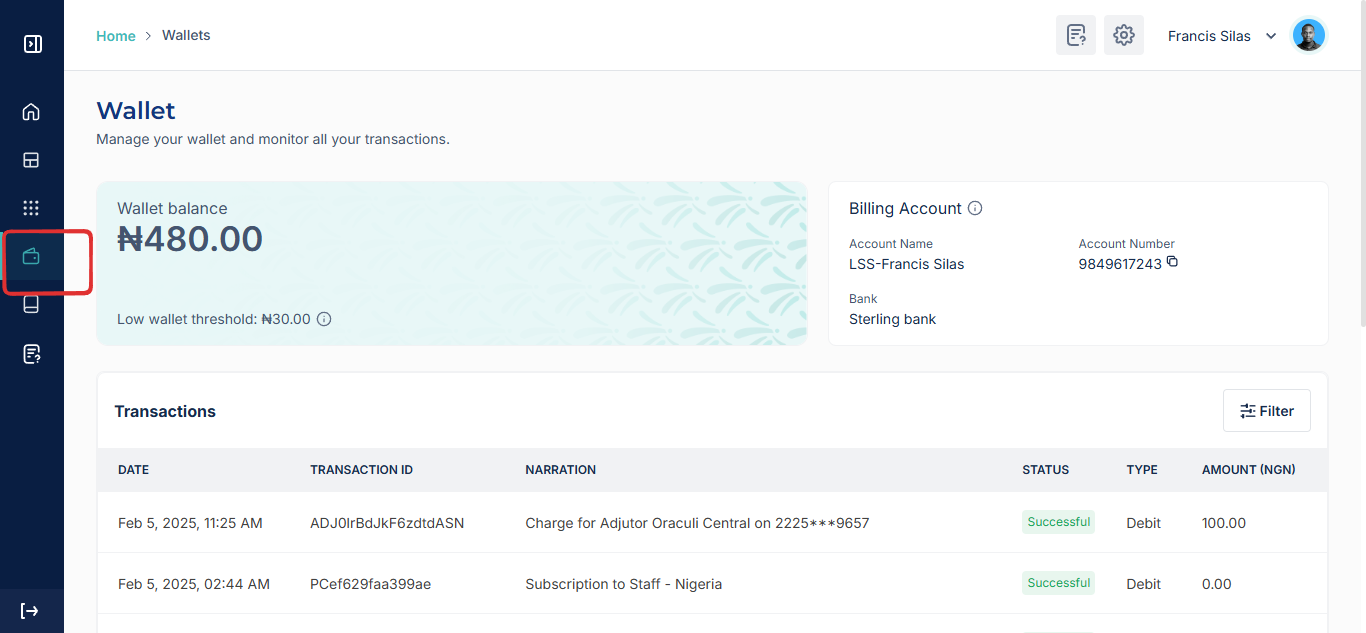
Adjutor operates on a prepaid wallet model. You load funds into your service wallet, and API charges are automatically deducted as you make calls. This model provides clear cost visibility and prevents surprise bills. You can monitor your wallet balance in real time and receive alerts when balances run low, ensuring uninterrupted service.
Your unique account details for funding are displayed on the Wallet page, enabling you to transfer funds directly to your service wallet. You can review all wallet activities in the Transactions section, including timestamps, amounts, and the specific endpoints accessed for clear financial tracking.
Create an app and retrieve API keys
Adjutor uses an app model to manage API access. Each app represents a unique API identity with its own credentials, allowing you to create multiple apps under your organization for better security and to keep integrations organized.
For example, you could create one app that your core loan platform uses with full access to all APIs. Then you might create a separate app just for your CRM system, which only needs read access to customer data for sending communications. This separation improves security by limiting each integration point to only the permissions it actually needs.
When you create an app, Adjutor displays two critical values: your Client ID and Client Secret. The Client ID is your public identifier, while the Client Secret is your private key that proves your app’s identity when making API calls. Copy these somewhere secure immediately, as Adjutor will not show the client secret again. Store your client secret in secure infrastructure like AWS Secrets Manager, Azure Key Vault, or similar secure storage. Never put your client secret in frontend code or commit it to version control.
Integrate APIs into your application
With your API credentials secured, you can begin integrating Adjutor endpoints into your lending application. Adjutor provides comprehensive documentation at https://docs.adjutor.io/ and API references at https://api.adjutor.io/ that detail endpoint URLs, required parameters, authentication methods, response formats, and error handling.
Most integrations follow a standard pattern. Your application collects borrower information through your loan application form. When verification is needed, your backend sends authenticated requests to relevant Adjutor endpoints, passing borrower details as parameters. Adjutor processes the request, queries the relevant data source, and returns results instantly. Your application receives the response, parses the data, and uses it to inform approval decisions or flag issues requiring manual review.
Before going live, thoroughly test your API integrations in Adjutor’s sandbox environment. The sandbox mimics production behavior but uses test data, allowing you to verify your integration works correctly without consuming real API credits or affecting actual borrower data. Test various scenarios including successful verifications, failed verifications, missing data, and error conditions to ensure your application handles all responses appropriately.
Deploy to production and monitor
Once testing confirms everything works correctly, deploy your integration to production. Monitor API call volumes, success rates, response times, and costs closely during the initial rollout. This monitoring helps you identify any issues quickly and understand actual API costs compared to projections.
Best practices for API integration
Successfully leveraging Adjutor APIs requires more than just technical integration. Following operational best practices ensures you maximize value while maintaining security and reliability.
Implement proper error handling
APIs sometimes fail due to network issues, service outages, or invalid requests. Your application must handle these failures gracefully rather than crashing or showing confusing error messages to users. Implement retry logic for temporary failures, show clear messages to users when verification cannot be completed, log errors for debugging and monitoring, and have fallback processes for when APIs are unavailable.
Cache responses appropriately
Some API responses, particularly credit bureau data, remain valid for periods of time. Rather than calling expensive APIs repeatedly for the same information, cache responses where appropriate and reuse them within validity windows. This reduces costs and improves application performance.
Secure API credentials
Your API keys provide access to sensitive data and services you are paying for. Treat them with the same security as passwords or encryption keys. Rotate credentials periodically, restrict access to need-to-know personnel, monitor for unauthorized usage, and immediately revoke credentials if compromise is suspected.
Monitor API usage and costs
Track which APIs you call most frequently, what they cost, success rates for different endpoints, and how API data influences approval decisions. This monitoring helps you optimize your API usage over time, identifying opportunities to reduce costs or improve decision accuracy.
Stay current with API updates
Adjutor periodically updates APIs to add features, improve performance, or change pricing. Subscribe to Adjutor’s update notifications and regularly review documentation to stay informed about changes that might affect your integration.
By leveraging Adjutor’s comprehensive API suite, lenders gain access to the data infrastructure and verification capabilities that were once available only to large institutions with significant technology budgets. This democratization of lending technology allows lenders of all sizes to make faster, more informed, and more accurate credit decisions while delivering modern digital experiences that today’s borrowers expect.