Access your Back Office at your fingertips.
Download the app now on Google Play Store.
Scan the QR code
You can also scan QR code with your phone to download the app.
Understanding Karma and how it blocks bad actors in Lendsqr
Updated
On this page
Lending platforms often face a major challenge – borrowers who repeatedly take loans across multiple lenders without repaying them. These borrowers create significant financial risk, increase portfolio losses, and reduce overall lending efficiency. To address this problem, Lendsqr uses Karma, a risk management service designed to identify and block repeat defaulters and bad actors from accessing loans.
Karma acts as a shared borrower intelligence system that helps lenders detect users with a history of non-repayment before loans are approved. Borrowers who demonstrate a consistent pattern of defaulting on loans acquired from multiple lenders can be reported to the Karma system and restricted from accessing future credit.
This guide explains how Karma works, why it matters, and how lenders can use it to strengthen their credit risk strategy.
Karma is a borrower screening and fraud prevention service within the Lendsqr ecosystem. It is designed to identify borrowers who have established a pattern of loan default or irresponsible borrowing behavior across multiple lenders.
When a borrower consistently fails to repay loans, their identifying information may be added to the Karma system. This includes identifiers such as:
Bank Verification Number (BVN)
Phone number
Email address
Once recorded, this information becomes part of a centralized risk database that can be used during loan evaluation.
For example, if a borrower defaults on loans from several lenders and later attempts to apply for a loan through your platform, Karma can automatically flag or disqualify the borrower based on their previous repayment behavior.
This helps lenders avoid extending new credit to individuals who have already demonstrated high-risk borrowing patterns.
Why Karma matters for lenders
Managing lending risk goes beyond evaluating a borrower’s income or credit score. Historical repayment behavior is one of the strongest indicators of future loan performance.
Karma helps lenders strengthen decision-making by providing visibility into borrower behavior beyond their own platform. Instead of relying solely on internal repayment history, lenders gain access to a broader layer of borrower intelligence.
This is especially important for digital lending environments where borrowers may simultaneously access loans from multiple providers.
By using Karma, lenders can reduce exposure to serial defaulters and improve portfolio quality. It also minimizes losses associated with repeat non-payment and helps ensure that lending resources are directed toward more reliable borrowers.
In addition, Karma improves operational efficiency by automatically screening borrowers during loan applications. Instead of manually investigating borrower history, the system performs checks instantly as part of the evaluation process.
How Karma works in loan eligibility
Karma integrates directly into a lender’s loan eligibility and risk assessment workflow.
When a borrower submits a loan application, the system automatically checks their details against the Karma database using identifiers such as BVN, email address, or phone number.
If the borrower appears on the database due to a history of repeated non-repayment or suspicious borrowing behavior, the application can be automatically restricted based on your configuration settings.
This means the borrower may become immediately ineligible for loans on your platform without requiring additional manual review.
For example, imagine a borrower who has defaulted on multiple loans across different lending institutions. Even if that borrower meets other loan criteria such as employment verification or income level, Karma may still prevent approval because of their repayment history.
This creates an additional layer of protection within the lending process.
How lenders use Karma for risk management
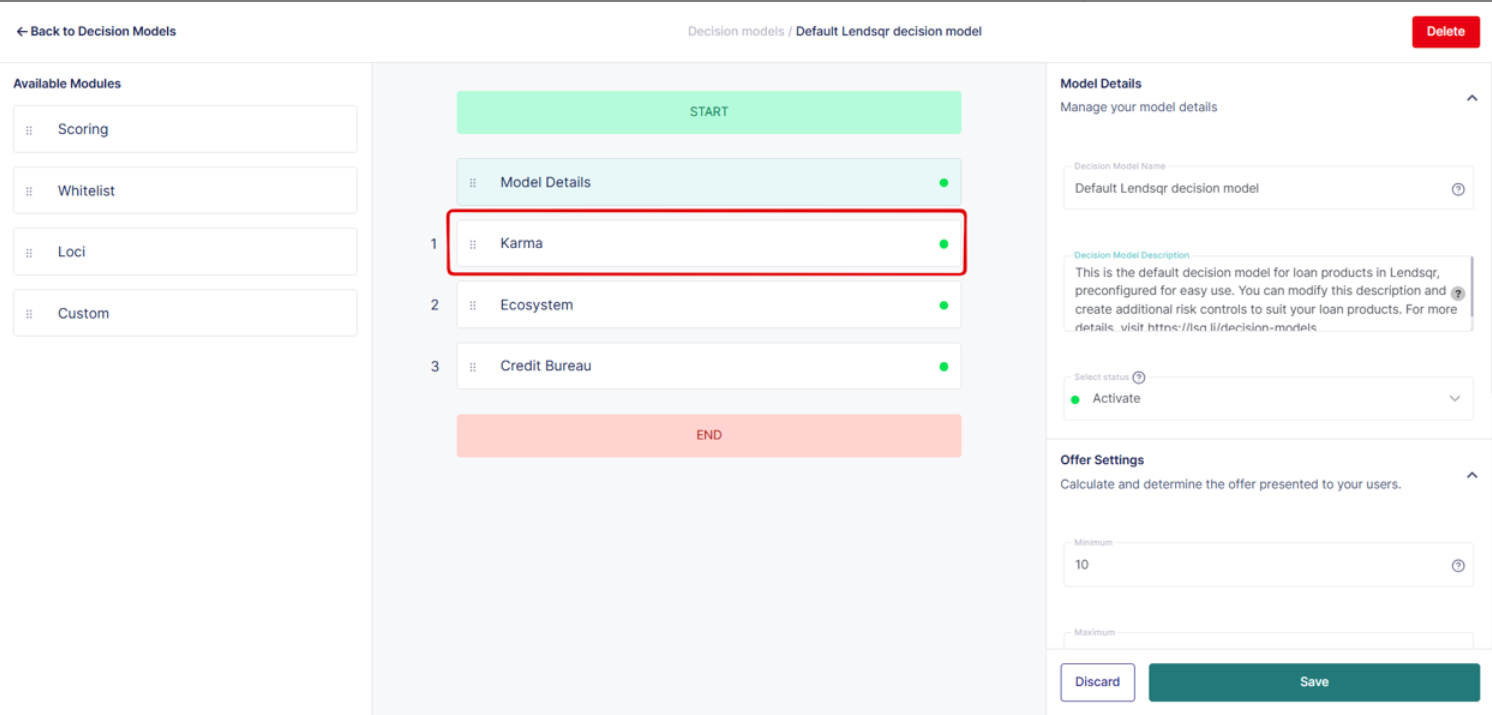
Karma can be configured as part of your lending eligibility rules to strengthen credit decisions and reduce unnecessary risk exposure.
Lenders often integrate Karma checks into their broader credit risk workflows to ensure borrowers meet acceptable repayment standards before approval.
For example, a lender offering salary advances may configure Karma to automatically disqualify borrowers with histories of repeated default, while still allowing first-time borrowers or customers with strong repayment behavior to proceed through normal evaluation.
This approach helps balance access to credit with responsible lending practices.
Karma is particularly useful for lenders operating in high-volume digital lending environments where fast but reliable loan decisions are critical.
Karma helps lenders identify repeat defaulters before loans are disbursed, reducing exposure to borrowers with poor repayment histories.
This improves overall portfolio quality and helps reduce bad debt.
Automated borrower screening
Instead of manually reviewing repayment concerns, lenders can rely on automated checks that occur instantly during the application process.
This speeds up decision-making while maintaining strong risk controls.
Better portfolio performance
By reducing approvals for known bad actors, lenders improve repayment outcomes and maintain healthier loan books over time.
This contributes to more sustainable lending operations.
Stronger fraud prevention
Karma also acts as a deterrent against fraudulent borrowing behavior by limiting the ability of repeat defaulters to move between lending platforms undetected.
This creates a more secure lending ecosystem for both lenders and responsible borrowers.
Conclusion
Karma is an essential risk management tool that helps lenders identify and restrict borrowers with a history of repeated non-repayment across multiple lending platforms. By leveraging borrower intelligence tied to identifiers such as BVN, phone number, and email address, lenders can automatically disqualify bad actors and reduce exposure to preventable defaults.
When integrated into loan eligibility workflows, Karma improves portfolio quality, strengthens decision making, and supports more responsible lending practices. For lenders seeking to balance growth with risk control, it provides an additional layer of confidence in every lending decision.