Access your Back Office at your fingertips.
Download the app now on Google Play Store.
Scan the QR code
You can also scan QR code with your phone to download the app.
Configuring offer letter on your savings product
Updated
On this page
What is a savings offer letter?
An offer letter in savings is a formal document provided to a customer outlining the terms and conditions of the savings plan being created. This document includes critical information such as the amount to be saved, the interest rate, the savings duration, the withdrawal terms, and any applicable fees. The offer letter serves as an agreement between the platform and the customer, ensuring clarity and transparency before the savings plan begins.
For lenders and savings providers using Lendsqr’s platform, configuring offer letters for your savings products is an essential step to streamline the savings plan creation process and ensure customers clearly understand their commitments before funds are locked into a plan.
Understanding the importance of savings offer letters
Offer letters play a crucial role in the savings ecosystem by establishing clear expectations and protecting both the savings provider and the customer. In an environment where financial products can be complex and terms may vary significantly between different savings plans, having a formal document that spells out every detail becomes not just helpful but necessary.
From a legal and compliance perspective, offer letters create a paper trail that demonstrates you communicated all relevant terms to customers before they committed their money. If disputes arise later about interest rates, withdrawal penalties, or maturity dates, you can refer back to the signed offer letter showing exactly what the customer agreed to. This documentation protects your business from potential claims of miscommunication or unfair practices.
Offer letters also enhance customer trust and confidence. When customers receive a professional, detailed document explaining their savings plan, they feel more secure about locking their funds into the product. The formality of an offer letter signals that you take their financial commitment seriously and operate with transparency.
Beyond legal protection and trust building, offer letters serve an educational purpose. Many customers, especially those new to formal savings products, may not fully understand concepts like compounding interest, lock-in periods, or early withdrawal penalties. A well-structured offer letter walks them through these concepts in the context of their specific plan, helping them make more informed decisions.
Key components of a savings offer letter
A comprehensive savings offer letter should contain several essential elements that together provide a complete picture of the savings arrangement. Understanding these components helps you design offer letters that truly serve their purpose.
The savings amount represents one of the most fundamental details. The offer letter should clearly state how much the customer will be saving, whether it is a lump sum deposit or recurring contributions. If the plan involves periodic deposits, specify the frequency, such as daily, weekly, or monthly, and the amount for each deposit.
Interest rate information must be presented clearly and unambiguously. State the annual interest rate, how it is calculated, whether it is fixed or variable, and how often interest is compounded. For example, an offer letter might specify a 12% annual interest rate compounded monthly. Customers need to understand not just the rate but also how it translates into actual returns on their savings.
The savings duration or tenor is another critical element. Customers need to know exactly how long their funds will be locked in before they can access them without penalties. This might be expressed as a specific number of days, months, or years, or it might reference a specific maturity date.
Withdrawal terms and conditions should be explained in detail in the offer letter. Specify whether early withdrawals are permitted and, if so, what penalties apply. Some savings products allow partial withdrawals, while others require breaking the entire plan. Clarify whether there are any restrictions on withdrawals even after the maturity date.
Fee information should be fully disclosed. If your savings product charges account maintenance fees, transaction fees, or any other costs, these must be clearly stated in the offer letter. Transparency about fees prevents customer complaints and builds trust.
Payment or contribution methods should also be explained. Let customers know how they will fund their savings plan, whether through bank transfers, debit card payments, wallet deductions, or automatic salary deductions. Include details about payment schedules and deadlines.
Interest payment terms need clarification as well. Explain when and how customers will receive their interest earnings. Some products pay interest at maturity, others pay monthly or quarterly. Some add interest to the principal for compounding while others disburse it separately.
Benefits of implementing offer letters for savings products
Integrating offer letters into your savings product workflow delivers multiple advantages that improve both operational efficiency and customer satisfaction.
First and foremost, offer letters reduce disputes and misunderstandings. When every detail is documented upfront, and the customer has acknowledged receipt and understanding of the terms, there is far less room for confusion later. If a customer claims they did not know about a particular fee or restriction, you can reference the offer letter they accepted.
Offer letters also streamline the customer onboarding process. Instead of sales or customer service teams having to verbally explain every detail of a savings plan, customers can review the offer letter at their own pace, ask questions about specific clauses, and make informed decisions. This self-service aspect reduces the burden on your support team.
How offer letters protect customers
While offer letters clearly benefit savings providers, they equally protect customers by ensuring they enter savings arrangements with full knowledge and consent.
Offer letters prevent predatory practices by requiring providers to disclose all terms upfront. A customer cannot be surprised by hidden fees or unexpected penalties if everything was clearly stated in the offer letter they reviewed and accepted before depositing funds.
Offer letters create a reference point customers can return to throughout the life of their savings plan. If they forget the maturity date or wonder whether early withdrawal is allowed, they can simply review their offer letter rather than having to contact customer support or rely on unclear memories of signup conversations.
For customers who are less financially literate, offer letters serve as educational tools. Reading through a well-structured document that explains interest calculations, compounding periods, and withdrawal restrictions helps them understand financial concepts that will serve them well beyond this single savings plan.
Steps to configure offer letters for your savings products
Setting up offer letters for your savings products on the Lendsqr platform is a straightforward process that ensures every customer receives proper documentation when creating a savings plan. Follow these steps to implement this important feature.
Step 1: Log in to the admin console
Open your web browser and navigate to the Lendsqr admin console. Enter your credentials, including your username and password, to access your account.
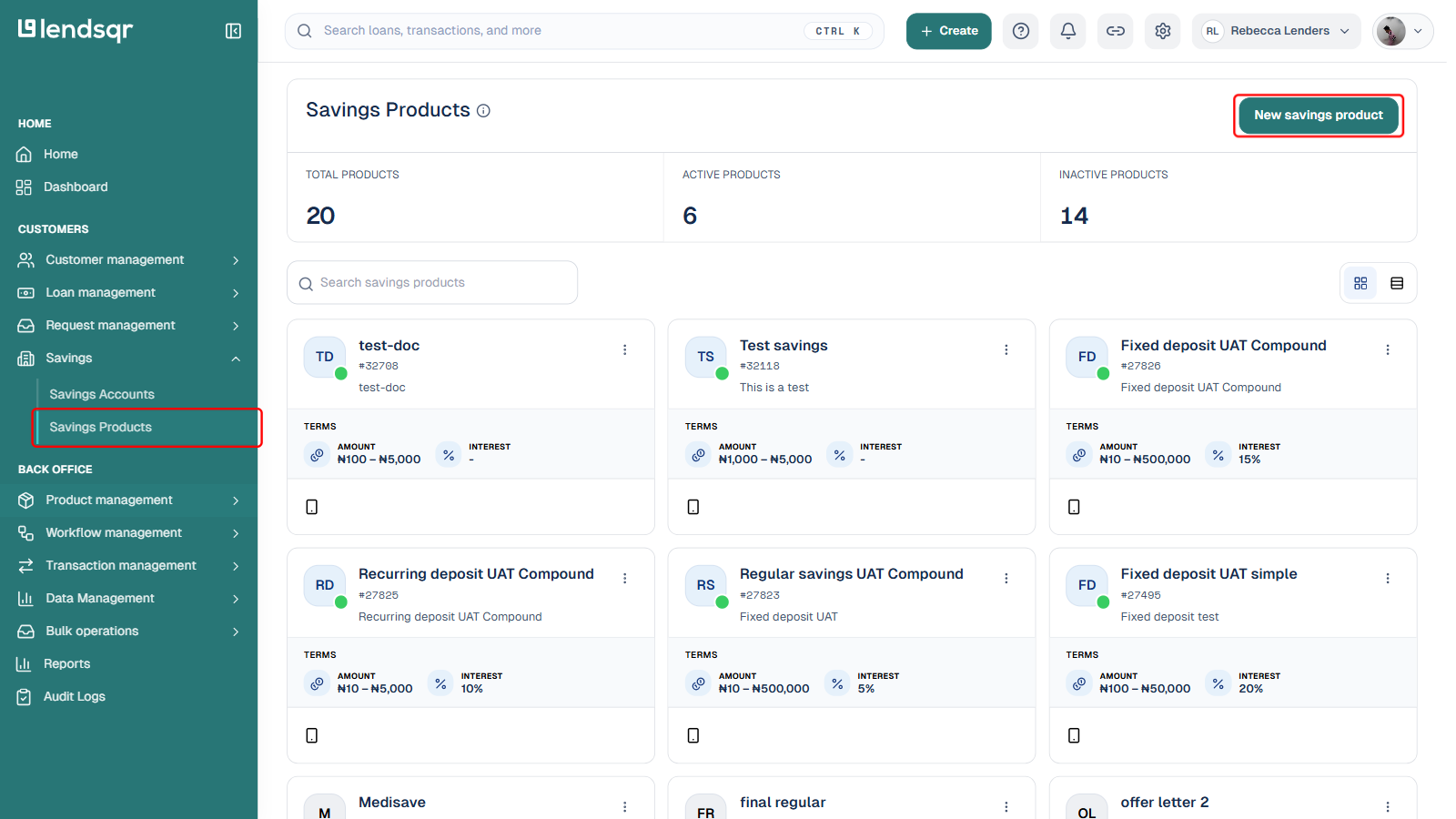
Step 2: Click on “Savings Products” under the Savings section
From the left navigation, expand the Savings section (under Customers) and select Savings Products. This action will display a comprehensive list of all the savings products you have created on your platform. You will see details such as product names, interest rates, minimum and maximum savings amounts, and the current status of each product.
Step 3: Create or edit a savings product
At this point, you have two options, depending on whether you are setting up a new savings product or modifying an existing one. To create a new savings product, click the Create button, typically located at the top or side of the savings products list. This will open a form where you can configure all aspects of your new savings product, including the product name, interest rate structure, tenor options, minimum and maximum deposit amounts, and other parameters. To edit an existing savings product, locate the product in your list and click the Edit button in the options menu for that product.
Step 4: Configure the savings offer letter
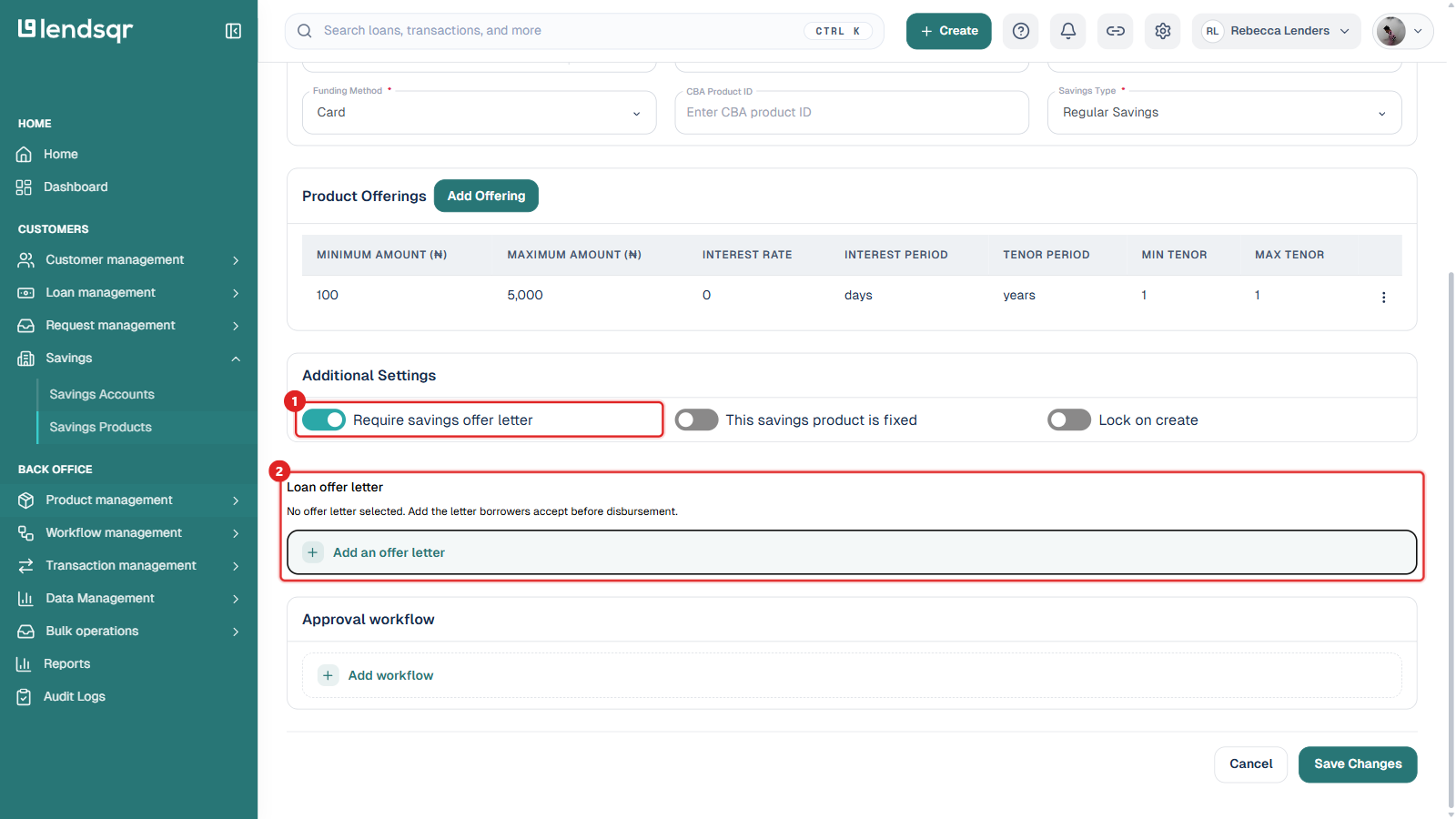
Once you are in the savings product creation or edit interface, scroll down to the Additional Settings section. It contains three toggles: Require savings offer letter, This savings product is fixed, and Lock on create. Switch on Require savings offer letter to activate the offer letter requirement for this savings product.
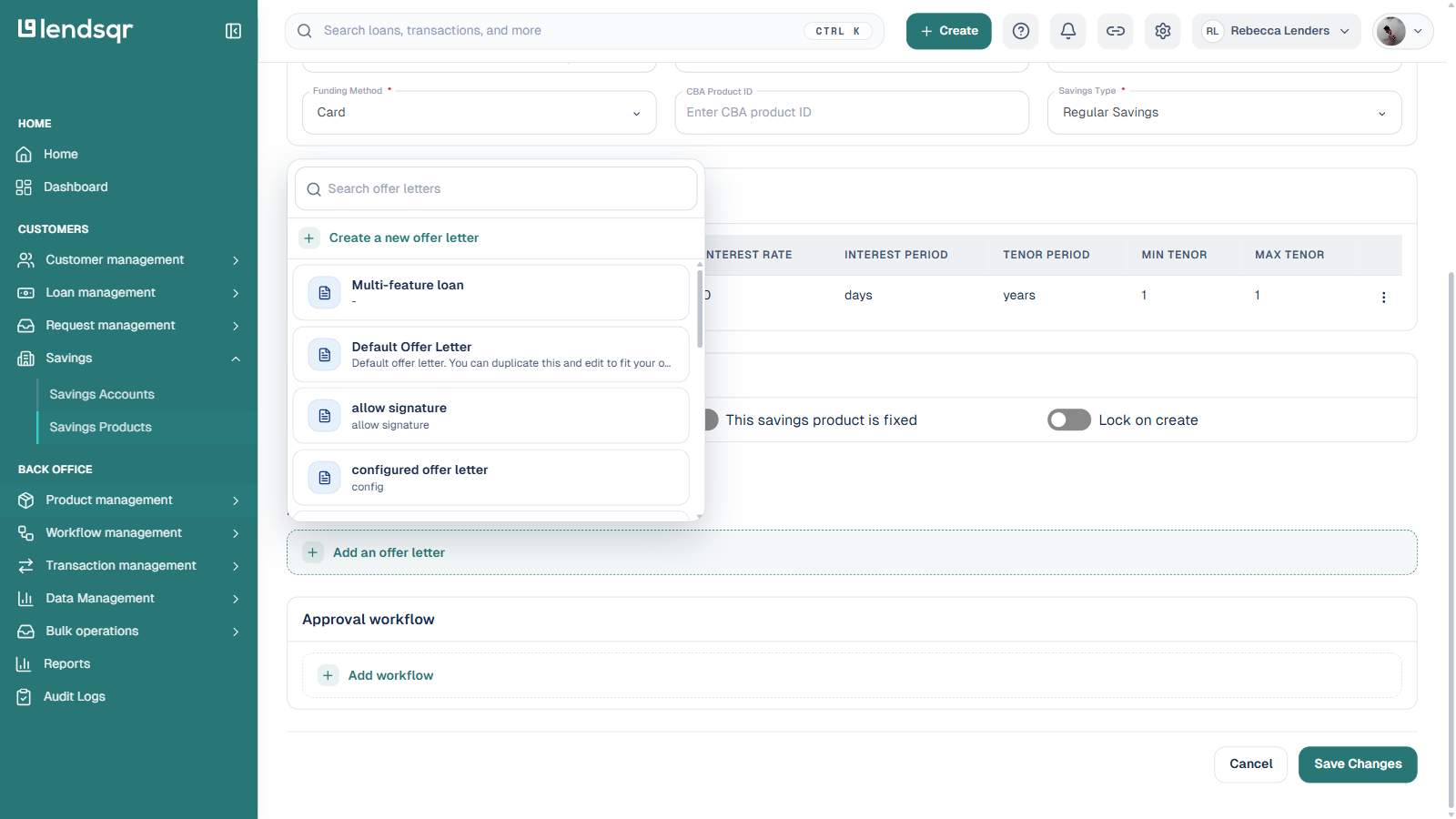
A Loan offer letter section then appears just below Additional Settings (it keeps the label “Loan offer letter” in the interface even for a savings product). It reads “No offer letter selected” until you assign a template. Click Add an offer letter to open the picker.
In the picker, search for and select one of your existing offer letter templates, or click Create a new offer letter to build one. The default template supplied by Lendsqr is called Default Offer Letter, which you can duplicate and edit to fit your own requirements.
Step 5: Save your changes or create a savings product
After making the necessary configurations, including enabling the offer letter requirement and selecting the appropriate template, review all your settings to ensure everything is correct. Once you are satisfied with all configurations, click the Save Changes button if you were editing an existing product, or click Create Savings Product if you were creating a new one.
Creating effective offer letter templates
Before you can assign offer letters to your savings products, you need to create well-designed templates that clearly communicate terms while remaining legally sound and customer-friendly.
Start with a clear and professional header that identifies the document as an official offer letter. Include your company name, logo, and contact information. This branding establishes authenticity and professionalism.
Use plain language throughout the document. While legal precision is important, avoid unnecessary jargon that might confuse customers. Terms like “principal amount” can be explained as “the total amount you will save” in parentheses the first time they appear.
Organize information logically with clear sections and headings. Group related information together so customers can easily find what they need.
Incorporate examples and calculations where appropriate. If your interest calculation is complex, show a sample calculation using round numbers. This helps customers understand exactly how their returns will be computed.
Add a signature section where customers can acknowledge they have read, understood, and agreed to the terms. In digital implementations, this might be an electronic signature or a simple checkbox confirmation.
Managing offer letters over time
Once you have offer letters configured for your savings products, ongoing management ensures they remain effective and compliant.
Review your offer letter templates regularly, perhaps quarterly or whenever regulations change. Financial compliance requirements evolve, and your documents need to stay current. Even small regulatory changes might necessitate updates to your offer letter language.
Collect feedback from customers and support teams about offer letter clarity. If customers frequently ask questions about specific clauses or terms, it might indicate that section needs clearer language or better explanation. Use this feedback to refine your templates.
Maintain version control for your offer letter templates. When you make updates, save new versions rather than overwriting existing ones. This practice ensures you can always reference the exact offer letter version that a particular customer signed, which becomes important for older savings plans.
Monitor completion rates to understand if offer letters are creating friction in the signup process. If a high percentage of customers abandon the process when they reach the offer letter stage, the document might be too complex or intimidating. Simplifying the language or breaking it into more digestible sections might improve completion rates.
Test offer letters across different devices and platforms. Ensure they display properly on mobile phones, tablets, and desktop computers. An offer letter that is easy to read on a laptop but becomes unreadable on a mobile screen will frustrate customers and reduce conversions.
Configuring offer letters for your savings products transforms the customer experience from informal to professional, from uncertain to transparent. By implementing this feature thoughtfully and maintaining it diligently, you build trust with customers, protect your business legally, and create a foundation for sustainable growth in your savings product offerings.