Access your Back Office at your fingertips.
Download the app now on Google Play Store.
Scan the QR code
You can also scan QR code with your phone to download the app.
How loan disbursement works
Updated
On this page
Introduction
Loan disbursement is the process of transferring approved loan funds to a borrower once a loan has been successfully reviewed and accepted in the system. In Lendsqr, this process is not a single fixed action. Instead, it is determined by the disbursement method selected during loan setup or booking. Each method defines how funds move through the system before they reach their final destination.
Understanding how disbursement works is important because it directly affects how money is tracked, recorded, and delivered. It also determines how fees, deductions, and additional adjustments such as upfront interest or equity contributions are applied before the borrower receives the funds.
Currently, Lendsqr supports three disbursement methods: wallet disbursement, bank disbursement, and third-party disbursement. While they serve different operational needs, they all follow a controlled flow to ensure accuracy, traceability, and proper financial reconciliation.
Wallet disbursement is the simplest form of loan payout in the system. In this method, once a loan is approved, the funds are credited directly into the borrower’s wallet within the Lendsqr platform. There are no intermediate transfers or external dependencies involved in this process.
When a loan is disbursed through the wallet, the borrower immediately sees the credited amount in their account balance. From that point, they can use the funds based on how the lender has configured wallet usage, such as repayments, transfers, or internal spending.
This method is typically used when lenders want to maintain full control within the platform environment or when the borrower does not require external bank transfers. It also reduces processing time because the funds do not need to pass through any external financial systems.
Use cases for wallet disbursement
Wallet disbursement is commonly used in micro-lending environments where borrowers frequently transact within the lender’s ecosystem. It is also useful for instant credit products where speed of access is more important than external transfer flexibility. In fintech platforms that operate closed-loop systems, wallet disbursement ensures that funds remain within the ecosystem for repayment and reuse.
Best practices for wallet disbursement
It is best practice to clearly define how wallet funds can be used before enabling this method, especially in products where borrowers might expect direct bank transfers. Lenders should also ensure that repayment rules are tightly integrated with wallet balances to avoid confusion or misapplication of funds. Monitoring wallet activity regularly helps identify unusual usage patterns early.
In operational setups, it is also advisable to communicate clearly to borrowers that funds will appear in their wallet first, even if they expect external transfers.
Bank disbursement
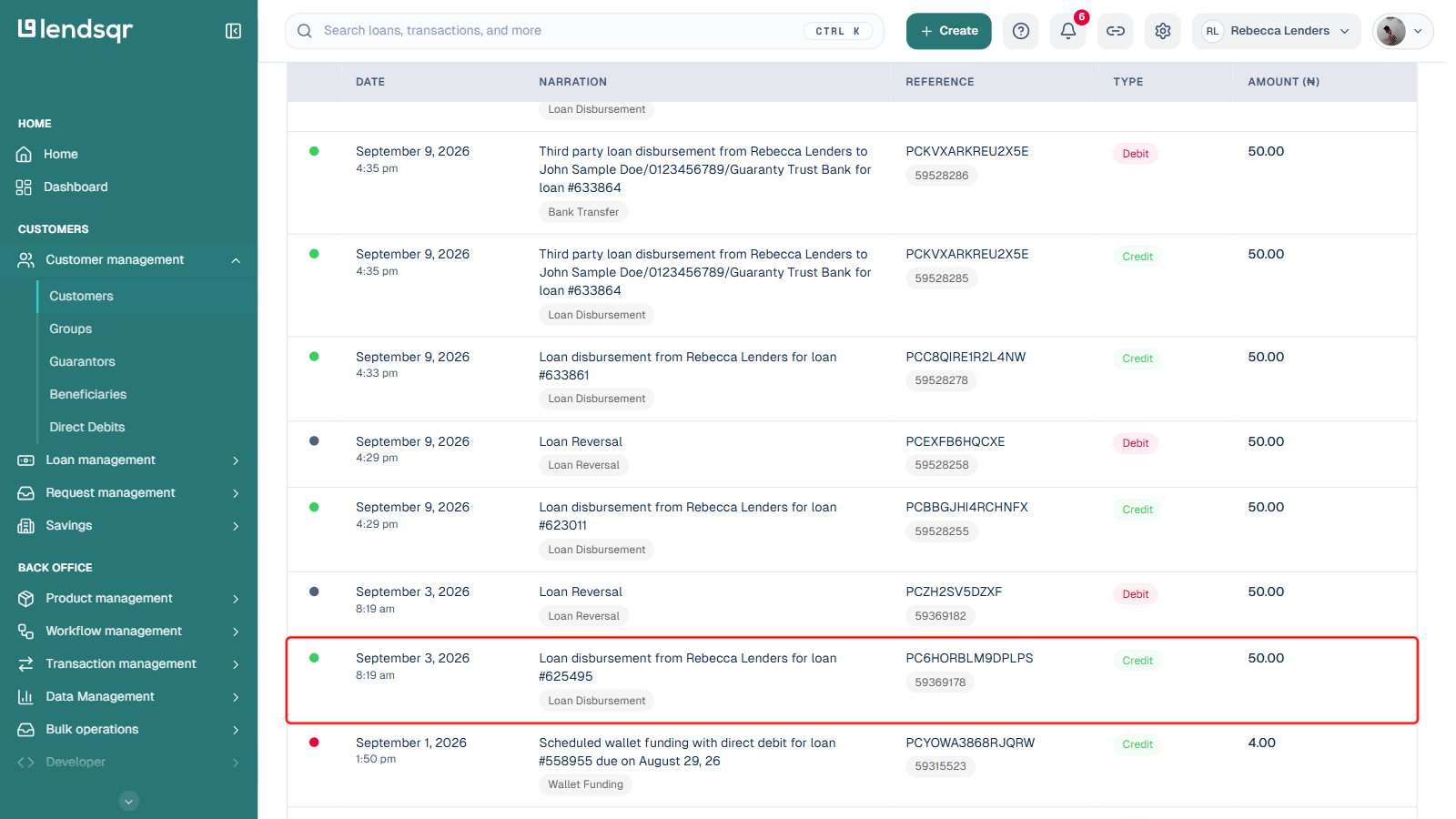
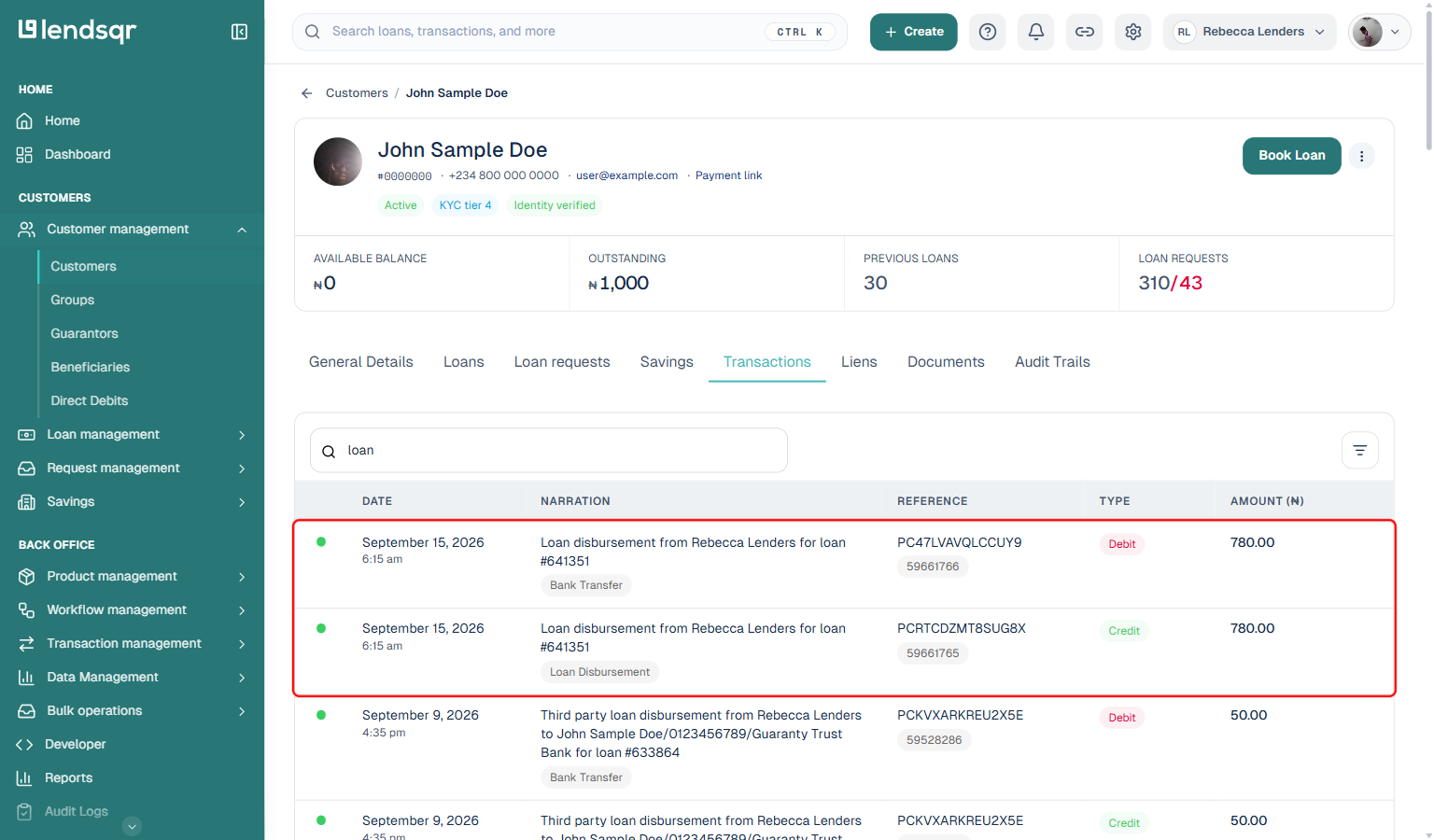
Bank disbursement introduces an additional step in the funding flow. In this method, the loan amount is first credited to the borrower’s wallet before being transferred to their registered bank account.
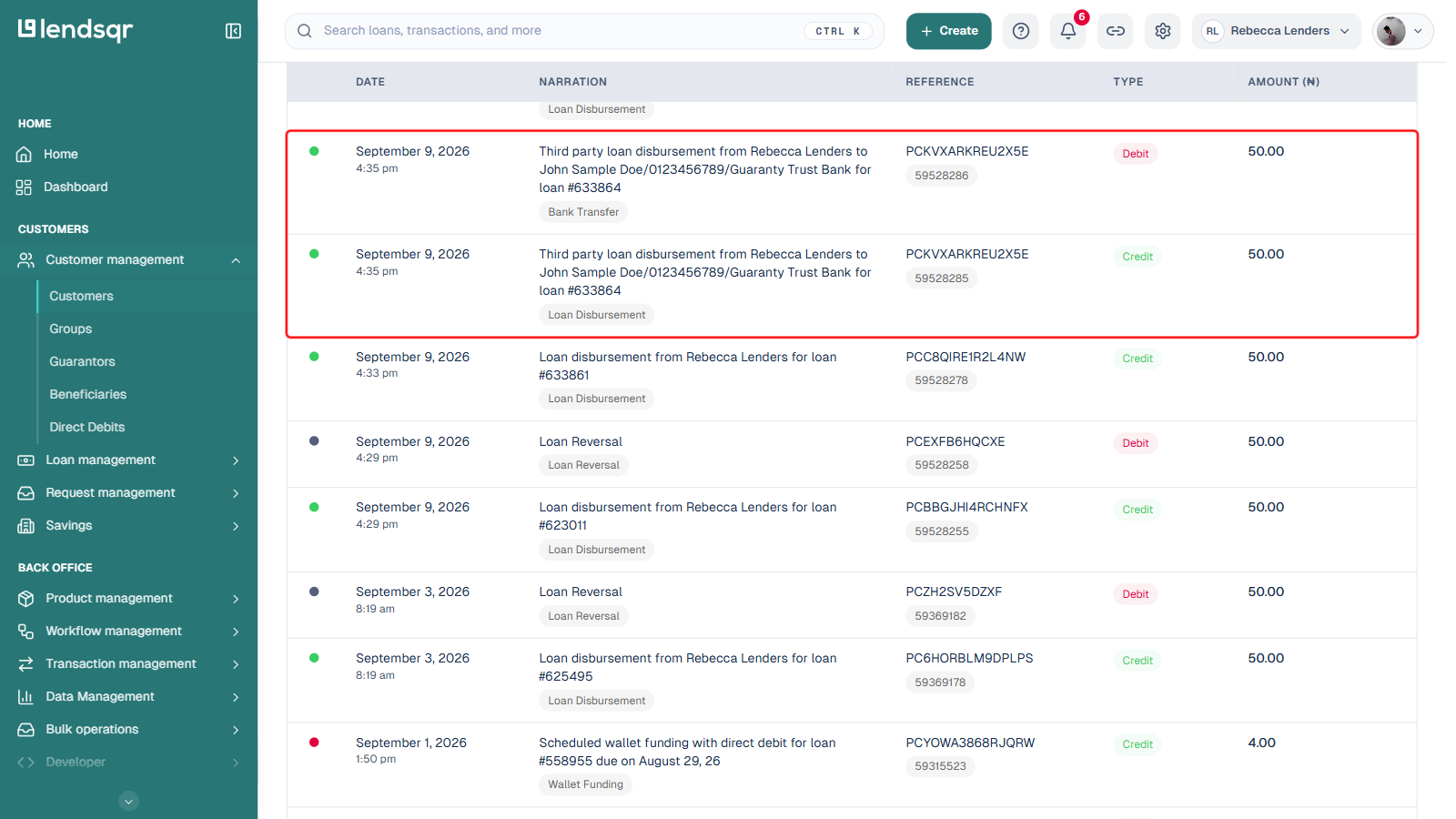
This means that two distinct transaction records are created during the process. The first transaction reflects the loan amount being credited into the wallet, and the second transaction reflects the transfer of funds from the wallet to the borrower’s bank account.
This two-step approach ensures that all necessary deductions, validations, or adjustments can be applied at the wallet level before the funds leave the system. It also provides a clear audit trail for both internal tracking and external reconciliation.
Bank disbursement is commonly used when borrowers prefer to receive funds directly into their bank accounts rather than holding them within the platform wallet.
Use cases for bank disbursement
Bank disbursement is typically used for personal loans, salary advances, and consumer lending products where borrowers expect funds in their bank accounts. It is also common in regulated lending environments where direct bank transfers are required for compliance or reporting purposes. Some lenders also use it for larger loan amounts where external bank visibility is necessary for financial tracking.
Best practices for bank disbursement
Lenders should ensure that borrower bank details are verified before enabling this disbursement method to avoid failed transfers. It is also important to account for banking delays, especially during weekends or public holidays, as these can affect settlement times. Maintaining clear reconciliation processes between wallet and bank transactions helps reduce accounting discrepancies.
It is also advisable to educate borrowers that bank disbursement involves an internal wallet step before funds arrive in their account, even though the final destination is external.
Choosing the receiving bank account
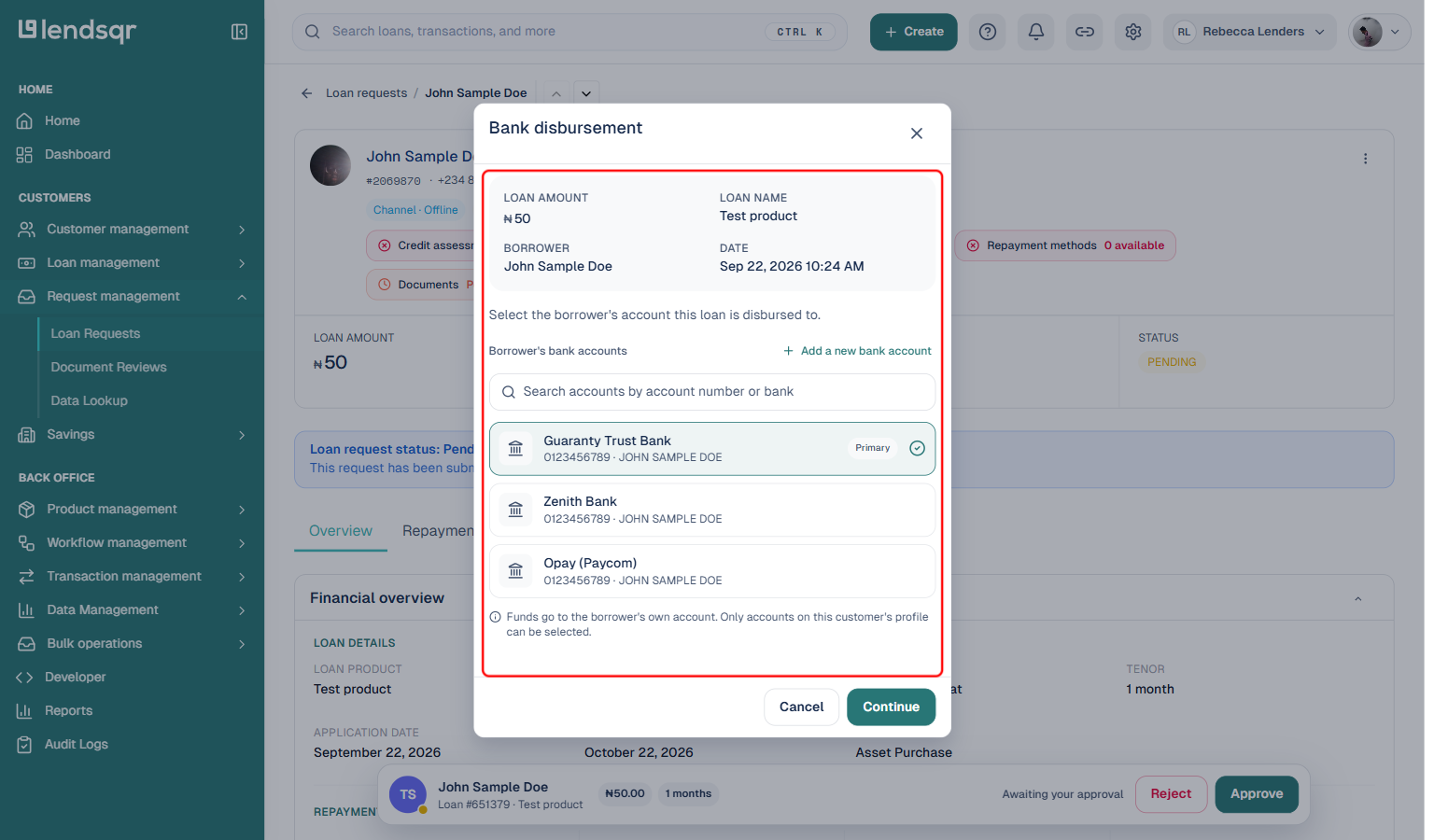
A borrower can have more than one verified bank account on their profile. When a loan set for bank disbursement is approved, the admin console asks the approver to confirm which of the borrower’s saved accounts should receive the funds, rather than picking one automatically. This confirmation happens at approval time, so the same loan offer can still go out to whichever account makes sense once it is actually approved.
The account selection screen lists every verified bank account on the borrower’s profile, with the bank name, account number and account name for each. If one of the accounts is marked as the borrower’s primary account, it is pre-selected, but any other saved account can be chosen instead. A search field lets the approver filter the list by account number or bank name when a borrower has several accounts, and an “Add a new bank account” option is available directly from this screen if the account the funds should go to is not yet saved to the borrower’s profile. Only accounts already linked to that customer’s profile can be selected, funds cannot be redirected to an account that does not belong to the borrower.
This step is most useful once a borrower has more than one eligible account on file, since it gives the approving team a final check before funds leave the wallet for an external account.
Third-party disbursement
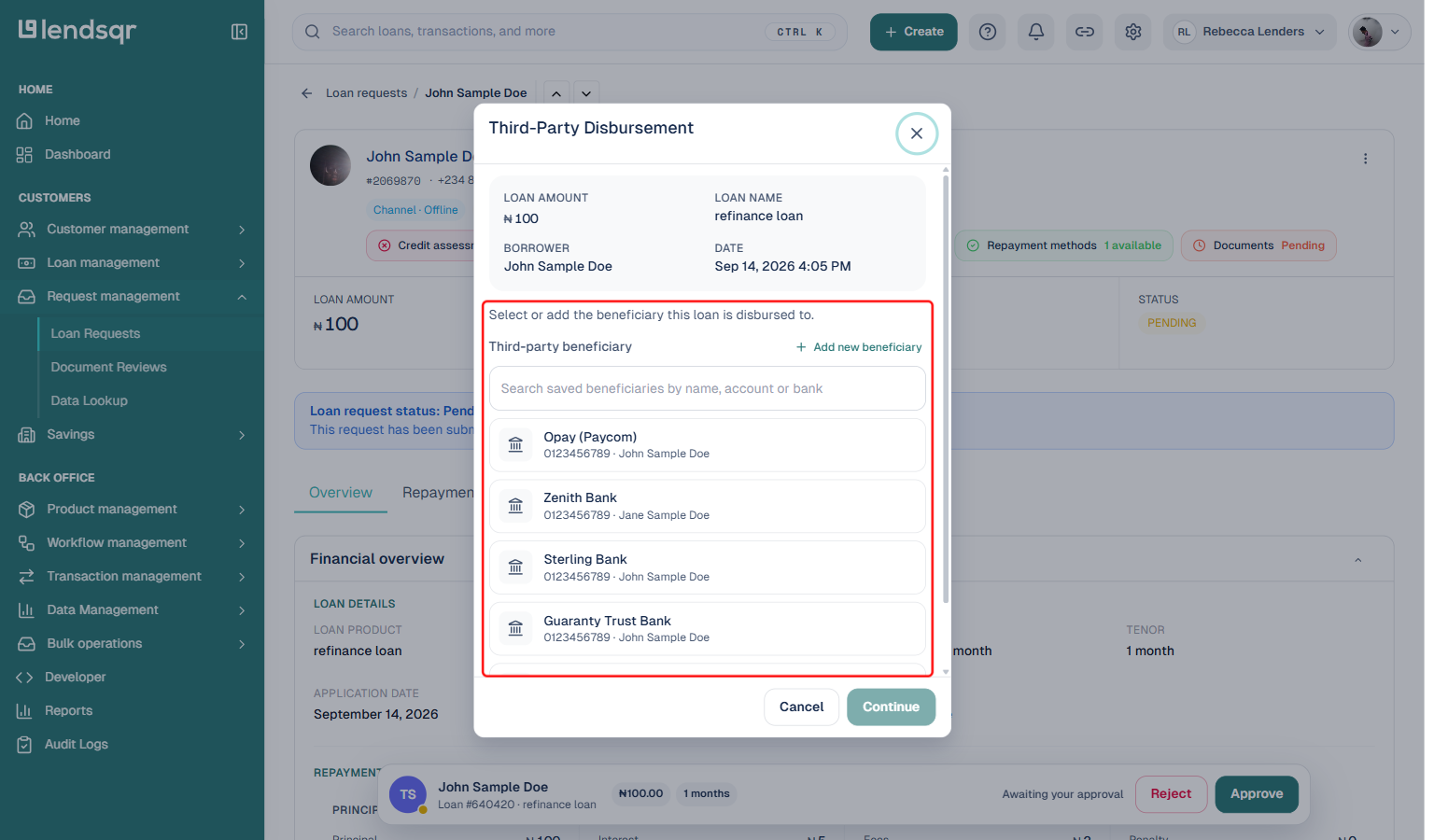
Third-party disbursement follows a similar structure to bank disbursement but is designed for external beneficiaries who are not necessarily the borrower.
In this method, loan funds are first credited to the borrower’s wallet and then transferred to a designated third-party recipient. This recipient could be a service provider, vendor, or any external entity specified during loan configuration.
The wallet acts as a controlled intermediary where all necessary checks and adjustments are applied before the final transfer is made. This ensures that any deductions such as fees or required contributions are properly handled before funds leave the system.
This method is particularly useful in structured lending scenarios such as asset financing or vendor-based loan disbursements where funds are not intended for direct borrower usage.
Use cases for third-party disbursement
Third-party disbursement is widely used in asset financing, where funds are sent directly to equipment or vehicle vendors. It is also used in education financing where tuition fees are paid directly to institutions. In supply chain financing, lenders often disburse funds directly to suppliers rather than borrowers to ensure funds are used for intended purposes.
Best practices for third-party disbursement
Lenders should carefully validate third-party recipients before enabling disbursement to prevent misdirected funds. It is also important to maintain clear documentation of why a third party is being paid to support audit and compliance requirements. Where possible, approval workflows should be used before executing third-party transfers.
Regular reconciliation of third-party payments helps ensure that funds are reaching the correct destinations and that loan purposes remain aligned with disbursement logic.
Role of the wallet as a processing layer
Across bank and third-party disbursement methods, the wallet consistently functions as an intermediary processing layer. This is intentional and ensures that the system can apply financial logic before funds are transferred externally.
For example, if a loan includes upfront interest payments, processing fees, or equity contributions, these amounts must be accounted for before final disbursement. The wallet provides a controlled environment where these deductions or adjustments can be applied accurately.
This design ensures that the borrower or recipient receives the correct final amount, while the system maintains a transparent record of all intermediate financial movements.
Key operational considerations
Loan disbursement flows are designed to be predictable, traceable, and consistent across all methods. Regardless of the channel used, every disbursement follows a structured process that ensures funds are correctly accounted for at each stage.
Wallet disbursement is the most direct method and results in immediate crediting of funds within the platform. Bank disbursement introduces an additional transfer step after wallet crediting, while third-party disbursement extends this flow to external recipients.
In all cases, the system ensures that required adjustments such as fees or upfront charges are applied before funds are fully released from the wallet.
One common point of confusion occurs when users expect bank or third-party disbursements to go directly from the loan account to the destination account. In Lendsqr, this does not happen because the wallet is always used as the intermediate processing layer. This is not an error but a core part of how the system ensures accuracy and traceability.
Another issue arises when expected funds do not immediately appear in a bank account. In such cases, it is important to check whether the wallet transfer has been completed first, as external transfers only occur after successful wallet crediting.
Delays can also occur if upstream integrations such as bank or third-party providers experience processing latency. In these situations, the wallet transaction will still be recorded even if the external transfer is pending.
Best practices for loan disbursement management
Lenders should clearly define which disbursement method applies to each loan product before deployment to avoid operational inconsistencies. It is also important to align disbursement methods with borrower expectations to reduce support requests and confusion.
Proper validation of borrower or recipient account details should always be completed before initiating bank or third-party transfers. Lenders should also monitor wallet transactions closely since it acts as the central point for all disbursement flows.
Finally, maintaining clear communication with borrowers about how funds move through the system helps improve transparency and trust, especially when multiple transaction steps are involved.
Concrete end-to-end examples of loan disbursement flows
Example 1: Wallet disbursement
A borrower is approved for a loan of ₦100,000, and the lender selects wallet disbursement. Once approved, the system credits the borrower’s wallet immediately.
The ledger records a single entry showing a debit from the loan disbursement account and a credit to the borrower wallet for ₦100,000. No additional transfer entries are created because the wallet is the final destination.
The borrower sees the funds instantly, usually within seconds. This method is commonly used for microloans or products where spending happens within the platform.
Example 2: Bank disbursement
A borrower is approved for a ₦250,000 loan, but the funds are meant for their external bank account.
The system first credits the borrower’s wallet with ₦250,000. The ledger records a debit from the loan account and a credit to the wallet. Immediately after, a second ledger entry records a debit from the wallet and a credit to the borrower’s bank account for the same amount.
The wallet step allows the system to apply any deductions or validations before external transfer.
The wallet credit happens instantly, while the bank transfer typically takes a few minutes to 24 hours depending on the receiving bank and settlement rails. This method is common in salary advances and personal loans.
Example 3: Third-party disbursement
A borrower is approved for a ₦500,000 loan intended for a vendor payment, such as asset financing.
The system first credits the borrower’s wallet with ₦500,000. The ledger records a debit from the loan account and a credit to the wallet. Next, a transfer is initiated from the wallet to the third-party vendor.
This creates a second ledger entry showing a debit from the wallet and a credit to the vendor account.
If fees or contributions apply, they are deducted before the final transfer. Wallet credit is immediate, while vendor settlement can take minutes to 24 hours depending on external processing systems.
Key insights across all flows
Across wallet, bank, and third-party disbursements, the wallet consistently acts as a processing layer. Even when the borrower never interacts with it directly, it ensures that all financial rules, deductions, and validations are applied before funds move externally.
Wallet disbursement ends at the wallet itself, while bank and third-party disbursements both require an additional transfer step after wallet crediting. This design ensures full traceability of every transaction from loan approval to final payout.
The system separates internal crediting from external settlement to maintain accurate ledger records and reduce financial discrepancies. This makes every disbursement predictable, auditable, and consistent across all loan products.
Conclusion
Loan disbursement in Lendsqr is structured around three core methods, each designed to support different lending scenarios while maintaining a consistent internal flow. Wallet disbursement provides direct crediting within the system, bank disbursement enables controlled transfer to external bank accounts, and third-party disbursement extends this capability to external recipients.
Despite the differences in final destination, all methods rely on the wallet as a central processing layer to ensure that fees, deductions, and financial adjustments are properly applied before funds are released. This structure ensures accuracy, transparency, and full traceability across all loan disbursement activities.