Access your Back Office at your fingertips.
Download the app now on Google Play Store.
Scan the QR code
You can also scan QR code with your phone to download the app.
What is a disbursement account?
Updated
On this page
A disbursement account on the Lendsqr admin console is the central account where all loan-related transactions are processed for a lender. Every time a loan is approved and funds are sent to a borrower, that transaction flows out of the disbursement account. Every time a borrower makes a repayment, the funds flow back into it. This single account handles both sides of the lending cycle, giving lenders a clear, unified view of their loan portfolio’s cash movement.
How it works
When a Nigerian lender signs up on Lendsqr, a dedicated disbursement account is automatically created for them. There is nothing to configure or request; it is ready from the moment the account is set up.
The disbursement account serves two core functions:
Loan Disbursement (Outflows): When a loan application is approved, Lendsqr disburses the loan amount to the borrower directly from this account.
Loan Repayment (Inflows): When borrowers repay their loans, whether in full or in instalments, the repayment amounts are credited back to this same account.
Because both directions of money movement pass through one account, lenders always have an accurate picture of their available funds, outstanding loans, and incoming repayments without needing to reconcile across multiple accounts.
Virtual account integration
Each disbursement account is linked to a unique virtual account number assigned specifically to the lender. This virtual account is the mechanism through which lenders fund their disbursement account.
Here is how the two relate:
The virtual account is the public-facing account number that a lender uses to transfer money in from their bank. It acts as the funding entry point.
The disbursement account is the internal operational account that Lendsqr uses to process loan payouts and receive repayments.
When a lender transfers funds to their virtual account number, those funds become available in the disbursement account and can immediately be used for loan disbursements. Borrower repayments also flow into this account automatically when processed through Lendsqr’s repayment infrastructure.
A practical example: from disbursement to repayment
To make this concrete, here is a walkthrough of a typical loan lifecycle on Lendsqr.
Setup: A lender, ABC Microfinance, signs up on Lendsqr. A disbursement account and a linked virtual account are created automatically.
Step 1 – Funding the account: ABC Microfinance transfers ₦500,000 from their business bank account to their Lendsqr virtual account number. The funds reflect in their disbursement account balance.
Step 2 – Loan approval and disbursement: A borrower applies for a ₦50,000 loan. The application is reviewed and approved through the Lendsqr admin console. Lendsqr disburses ₦50,000 to the borrower’s bank account. The disbursement account balance drops to ₦450,000.
Step 3 – Repayment: Two weeks later, the borrower repays ₦25,000 as their first instalment. After the repayment is processed and settlement is completed, the net amount is credited back to the disbursement account.
Step 4 – Full repayment: At the end of the loan term, the borrower pays the remaining ₦25,000 plus interest. The principal returns to the disbursement account and the interest is recorded separately per Lendsqr’s fee structure.
This cycle repeats for every loan. Because everything flows through one account, ABC Microfinance can see exactly how much they have deployed, how much has been repaid, and what is available for new disbursements at any point in time.
Viewing and managing your disbursement account on Lendsqr
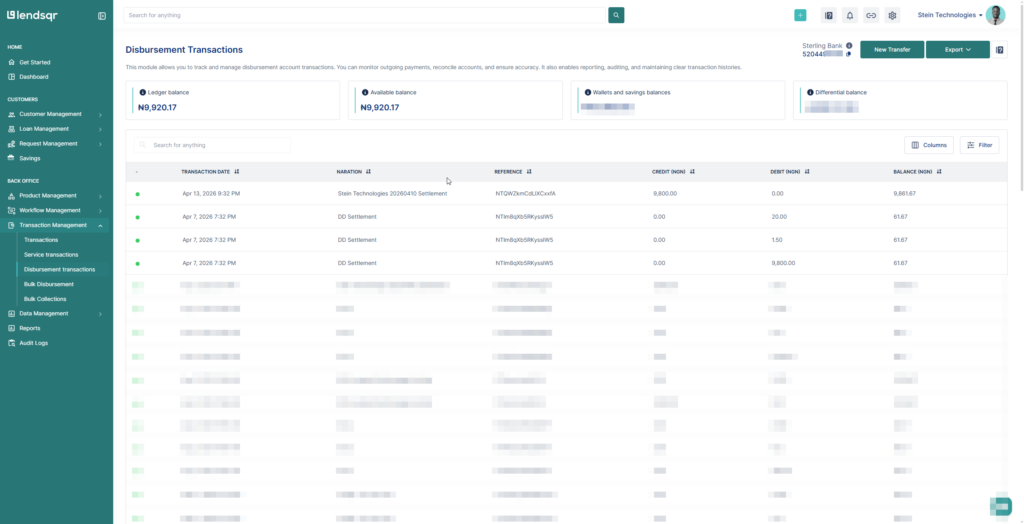
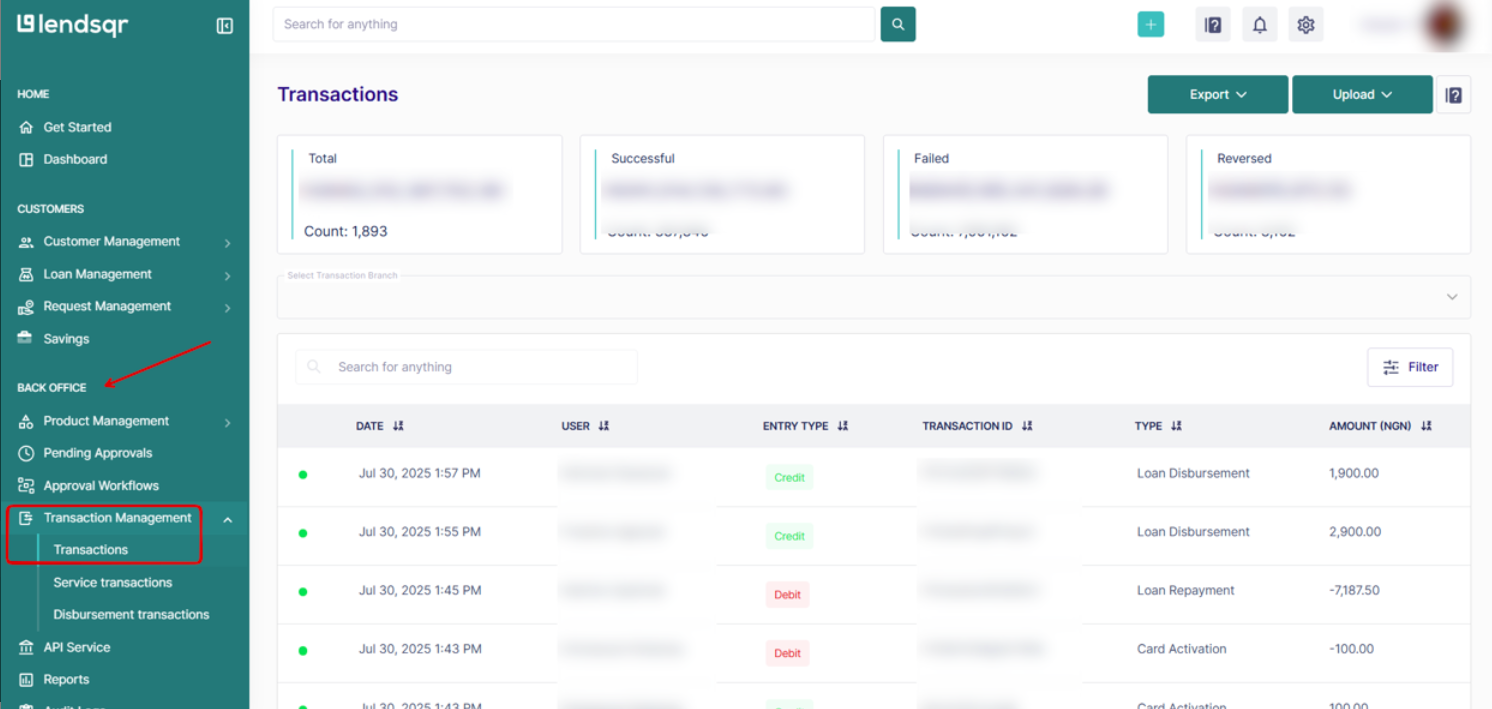
Viewing your disbursement account and tracking transactions
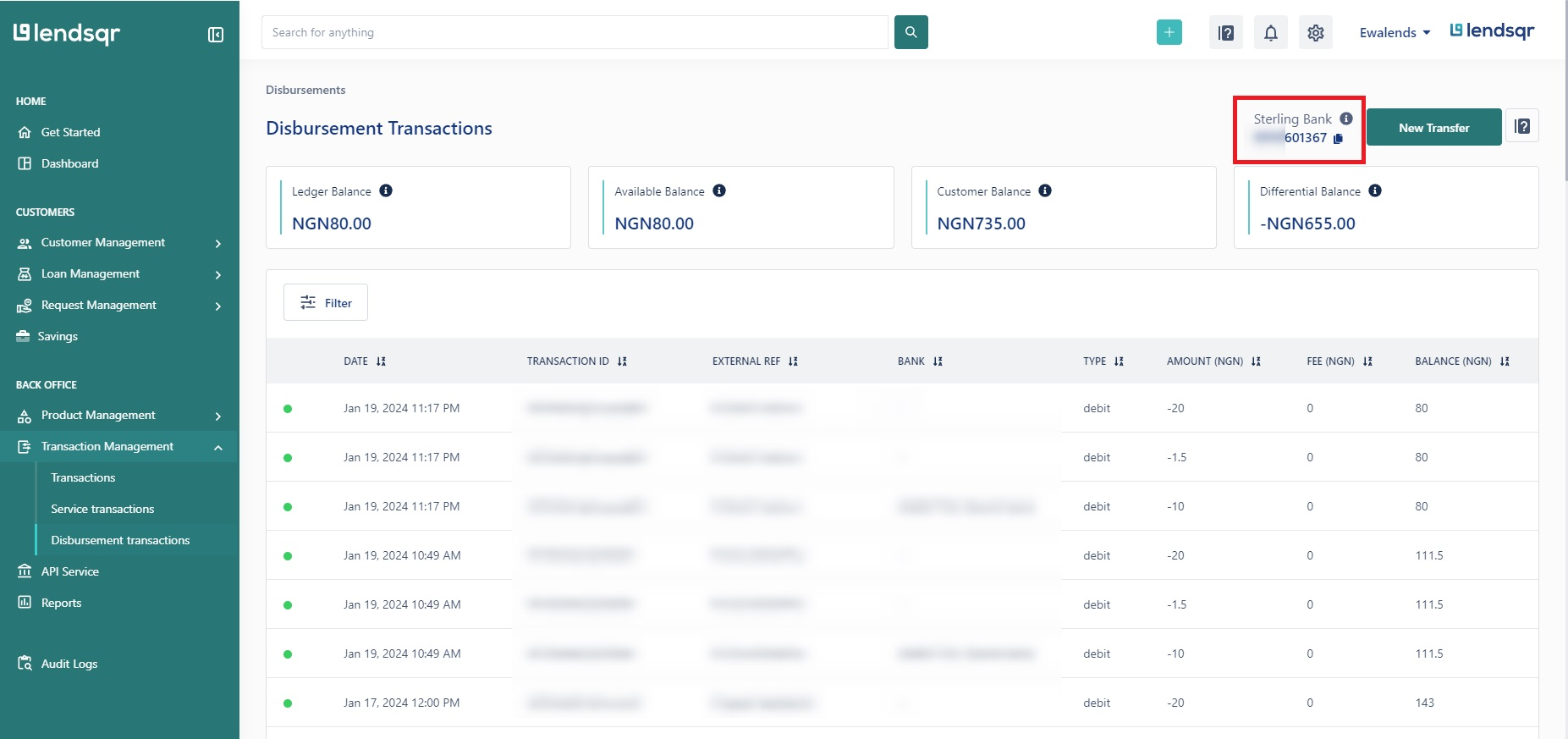
Here you can see your current balance, virtual account number, and a full log of all transactions. Use the filters to sort by date range, transaction type (inflow or outflow), or status.
Funding your disbursement account
From the same page, copy your unique virtual account number.
Transfer the amount you want to fund to that virtual account number using any bank channel available to you, such as USSD, mobile banking, or internet banking.
The funds will reflect in your disbursement account balance, typically within minutes depending on your bank.
Why it matters
A dedicated disbursement account gives lenders something that is easy to underestimate: operational clarity. Without it, lenders managing loan payouts and collections manually across regular bank accounts would need to track each transaction individually, reconcile inflows and outflows separately, and maintain their own records of what has been disbursed versus repaid.
Lendsqr’s disbursement account eliminates that overhead. Every transaction is logged automatically, balances are always current, and the connection between a disbursement and its corresponding repayments is maintained within the platform.
This is particularly valuable as a lending portfolio scales. The more loans in flight at any given time, the more difficult manual reconciliation becomes. Having a single, purpose-built account for loan transactions means lenders can focus on growing their portfolio rather than managing spreadsheets.
#1 What is the difference between Settlement and Disbursement Account?
Your settlement account receives all incoming funds processed through the Lendsqr app. You can link any corporate bank account of your choice, and Lendsqr will credit it with loan repayments and wallet top-ups. (credited the next business day), while the disbursement account is the funding source Lendsqr draws from to pay out approved loans. You have to keep it funded to avoid failed disbursals.
#2 What is the difference between disbursement and service balance?
The service balance covers fees charged for using Lendsqr’s services, while the disbursement balance is the funds available to pay out loans to borrowers.