Access your Back Office at your fingertips.
Download the app now on Google Play Store.
Scan the QR code
You can also scan QR code with your phone to download the app.
How to activate third-party disbursement
Updated
On this page
What is third-party disbursement?
Third-party disbursement on the Lendsqr admin console is a feature that allows a lender to disburse a loan amount into the bank account of a third party on behalf of the borrower. When a lender creates a loan product and enables third-party disbursements, the payment of the loan amount will go to the third party specified by the borrower during the loan application process, not the borrower.
When your users apply for a loan product that requires a third-party disbursement, they will be required to input the details of the third party such as name, address, email address, and account number in the loan application process. The details provided will be used by you to verify the beneficiary.
You can also view, add, and delete beneficiaries on the Lendsqr admin console. However, this feature is available for specific plans and subscriptions.
Understanding third-party disbursement
Third-party disbursement represents a significant shift in how loan funds are distributed in the lending ecosystem. Traditional loan disbursement models send funds directly to the borrower’s account, giving them full control over how the money is spent.
While this works well for general purpose loans, it creates challenges when loans are intended for specific purposes like purchasing goods, paying service providers, or settling bills with designated vendors.
The third-party disbursement feature addresses these challenges by allowing loan funds to bypass the borrower’s wallet or already provided default details. It can also go straight to the entity providing the goods or services. This creates a more controlled lending environment, allowing lenders to ensure loan proceeds are used for their intended purpose.
For borrowers, this feature provides access to financing even when they might not have the credit profile to qualify for unrestricted cash loans. Because the lender maintains control over where the funds go, they can afford to take on slightly higher-risk customers who demonstrate a genuine need for specific goods or services.
Understanding when and how to use third-party disbursement helps lenders design better loan products and serve their customers more effectively. Here are the most common scenarios where this feature proves valuable.
One major use case is asset financing. When customers want to purchase specific items like motorcycles for commercial transport, smartphones for business use, or appliances for their homes, lenders can partner with the vendors selling these items.
The borrower applies for a loan to buy a motorcycle, for example, and upon approval, the loan amount goes directly to the motorcycle dealer. The borrower receives the motorcycle while the dealer receives guaranteed payment, and the lender ensures the funds were used as intended.
Medical financing represents another significant application. Healthcare can be expensive and unexpected medical emergencies often require immediate funding. Lenders can partner with hospitals, clinics, and pharmacies to offer medical loans where disbursements go directly to the healthcare provider. This ensures patients get the care they need while providers receive timely payment.
Educational loans benefit greatly from third-party disbursement. Parents or students applying for school fees loans can have the funds sent directly to the educational institution.
This arrangement assures the lender that the money went toward education rather than other expenses, while schools receive guaranteed payment and families access financing for education.
Home improvement and renovation loans work well with this feature too. Customers seeking funds to renovate their homes can work with approved contractors. The loan amount goes directly to the contractor as work progresses, ensuring quality completion while protecting the lender’s interests.
Bill payment loans also leverage third-party disbursement effectively. Whether it’s utility bills, rent, or other recurring expenses, disbursing directly to the service provider ensures bills get paid while helping customers manage cash flow challenges.
E-commerce financing has emerged as a growing use case. Online marketplaces can integrate with lenders to offer buy now pay later options where the loan disbursement goes to the merchant while the customer receives the goods and repays over time.
Benefits of third-party disbursement for lenders
Implementing third-party disbursement offers several strategic advantages that can improve your lending business performance and reduce risk exposure.
It significantly reduces the risk of loan misuse. When you disburse directly to a third party for a specific purpose, you eliminate the possibility of borrowers diverting funds to unintended uses. A borrower who takes a loan to buy a generator cannot use that money to gamble or make other purchases when the funds go straight to the generator supplier.
While lenders gain significant advantages from this feature, borrowers also enjoy important benefits that make it an attractive financing option.
The feature also simplifies transactions for borrowers. Instead of receiving a loan, withdrawing cash, and then paying the vendor separately, the entire process happens seamlessly. The borrower applies, gets approved, and the vendor receives payment directly. This saves time and reduces the hassle of managing multiple transactions.
Third-party disbursement can also help borrowers avoid the temptation to misuse loan funds. When someone genuinely needs a loan for school fees but has the cash in hand, other pressing needs might tempt them to divert some funds. Direct disbursement removes this temptation and ensures their original goal is met.
Some lenders offer better terms on loans with third-party disbursement compared to general-purpose loans. Lower interest rates or longer repayment periods might be available because of the reduced risk, making financing more affordable for borrowers.
Steps to activate third-party disbursement for your loan product
Activating third-party disbursement on your loan products is a straightforward process. Follow these steps to enable this feature and start offering more targeted financing options to your customers.
Step 1: Navigate to loan products
On the Lendsqr admin console, navigate to the “Loan products” sub-tab which is under the “Product management” tab. This section displays all your existing loan products and provides options to create new ones. You will see a list of loan products you have already set up, along with their key details like interest rates, tenor options, and current status.
Step 2: Select or create a loan product
You have two options here. If you want to add third-party disbursement to an existing loan product, select that product from the list by clicking on it. If you are creating a new loan product specifically designed for third-party disbursement, click on the option to create a new loan product and fill in all the required details such as product name, interest rate, tenor range, loan amount limits, and other parameters. Once the loan product has been created and saved, proceed to edit it.
Step 3: Edit the loan product and configure disbursement settings
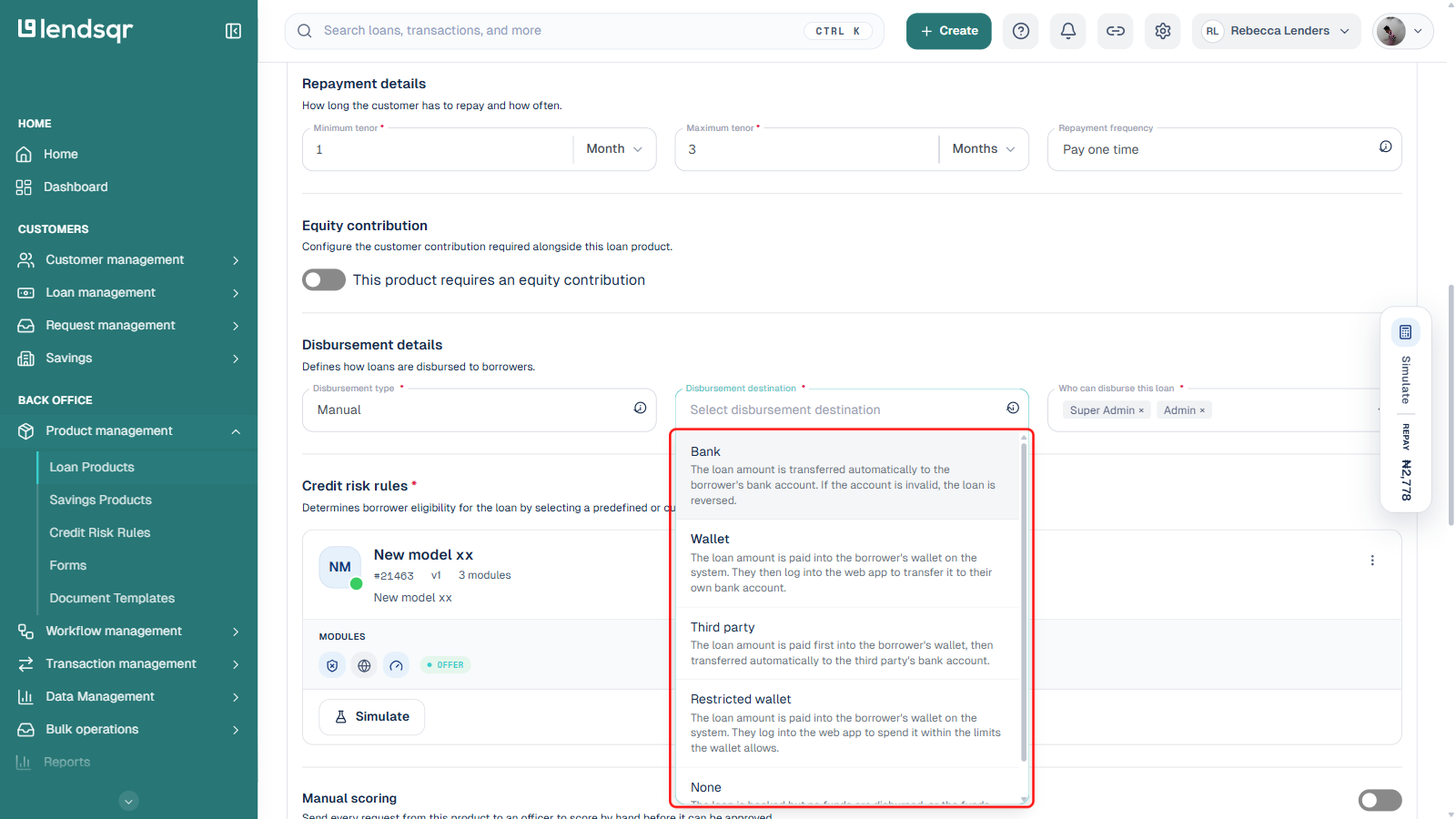
Scroll to the Disbursement details section within the loan product form. Click the Disbursement destination field, and you will see a list of every disbursement option available with a short description of what each one does: Bank (transferred automatically to the borrower’s own bank account), Wallet (paid into the borrower’s wallet for them to withdraw manually), Third party (paid into the borrower’s wallet, then transferred automatically to the third party’s bank account), Restricted wallet (paid into the borrower’s wallet for spending within set limits), and None (the loan is booked but no funds are disbursed). Select Third party to enable third-party disbursement for this product.
Step 4: Save your changes
After selecting third-party as the disbursement option, save your changes. The loan product is now configured to require third-party disbursement details during the application process. Any customer applying for this loan product must provide beneficiary information before their application can be completed.
Managing third-party beneficiaries
The platform also allows you to add beneficiaries directly from the admin console. This is particularly useful when you establish new partnerships with merchants or service providers. Instead of waiting for borrowers to input beneficiary details during loan applications, you can pre-register approved beneficiaries with verified account information. This speeds up the disbursement process and reduces errors from incorrectly entered beneficiary details. For the full walkthrough, see Creating a beneficiary on the Lendsqr admin console.
It is important to note that beneficiary management features may not be available on all Lendsqr plans. Check your current subscription level to confirm access to these advanced capabilities. If beneficiary management is critical to your operations, consider upgrading to a plan that includes these features.
Best practices for implementing third-party disbursement
To maximize the benefits of third-party disbursement while minimizing potential issues, follow these best practices.
Start by carefully vetting all third-party beneficiaries before approving them. Verify that merchants and service providers are legitimate businesses with proper registration and good reputations. Establish clear partnership agreements that outline expectations, disbursement processes, and dispute resolution procedures.
Communicate clearly with borrowers about how third-party disbursement works. Some customers may be unfamiliar with this model and might have concerns about funds not coming to their account. Explain the benefits, the process, and what they should expect at each stage.
Implement robust verification processes for beneficiary details. Before disbursing funds, confirm that the account number, bank name, and beneficiary name all match. A mismatch could indicate fraud or simple data entry errors, both of which need to be resolved before disbursement.
Monitor disbursement patterns for unusual activity. If a particular beneficiary suddenly receives a high volume of disbursements or if transaction amounts spike unexpectedly, investigate to ensure everything is legitimate. These patterns could indicate fraud rings or other schemes.
Maintain detailed records of all third-party disbursements including borrower details, beneficiary information, loan purpose, and disbursement dates. This documentation proves valuable for audits, dispute resolution, and performance analysis.
Finally, regularly review the performance of loans with third-party disbursement compared to traditional loans. Track metrics like approval rates, disbursement success rates, repayment performance, and default rates. Use this data to refine your processes and identify which use cases work best for your lending operation.
Third-party disbursement transforms lending from a simple cash transfer into a more strategic tool that serves specific customer needs while protecting lender interests. By implementing this feature thoughtfully and managing it well, you can expand your market reach, reduce risk, and build valuable partnerships that drive business growth.