Access your Back Office at your fingertips.
Download the app now on Google Play Store.
Scan the QR code
You can also scan QR code with your phone to download the app.
How to use prequalified borrowers to offer loans in Lendsqr
Updated
On this page
In digital lending, not every borrower who applies for a loan should be evaluated in the same way. Some customers are already known, trusted, or have been pre-approved based on historical data, behavioral patterns, or internal lender rules. To support this type of controlled lending approach, Lendsqr provides a feature known as prequalified borrowers.
Previously referred to as whitelists, prequalified borrowers allow lenders to define a set of users who are eligible for specific loan products without going through the standard discovery or qualification process. This helps lenders streamline loan origination, reduce risk for trusted customers, and create faster loan approval journeys for selected borrower groups.
This guide explains what prequalified borrowers are, why they matter, and how to configure and use them effectively within your lending operations.
Understanding prequalified borrowers
Prequalified borrowers are a curated list of customers who have been identified as eligible for specific lending products. These users bypass certain standard qualification checks because they already meet predefined criteria set by the lender.
In most lending systems, borrowers must go through a full evaluation process before being approved for credit. This includes credit checks, income verification, behavioral scoring, and other risk-based assessments. However, in some cases, lenders already have sufficient confidence in certain customers.
For example, customers with strong repayment history, salaried employees in partner organizations, or users who have successfully completed multiple loan cycles may be added to a prequalified group. These borrowers can then access loan products more quickly, with fewer friction points during the application process.
This approach improves efficiency while still maintaining control over lending decisions.
Why prequalified borrowers are important
The prequalified borrowers feature plays a critical role in balancing speed, trust, and risk management in lending operations.
One of the primary benefits is faster loan access for trusted customers. Instead of repeating full eligibility checks, lenders can instantly approve or prioritize users who already meet internal standards. This improves customer experience and encourages repeat borrowing.
Another important benefit is improved operational efficiency. By reducing the number of checks required for known customers, lenders can focus their risk and underwriting resources on new or higher-risk applicants.
Prequalified borrowers also help improve customer retention. When borrowers experience faster approvals and smoother loan journeys, they are more likely to return and continue using the platform.
Finally, this feature supports strategic lending segmentation. Lenders can design different borrowing experiences for different customer groups, such as salaried employees, gig workers, or high-value customers.
How prequalified borrowers work in Lendsqr
The prequalified borrowers feature works by linking specific users to defined loan products or eligibility rules. Once a borrower is added to the prequalified list, the system recognizes them during loan application and adjusts the decision flow accordingly.
Instead of going through full evaluation logic, the borrower may bypass certain checks or receive a simplified approval path depending on how the loan product is configured.
This does not mean risk is ignored. Instead, it means risk is managed in advance through selection criteria. Lenders are responsible for ensuring that only qualified users are added to the list.
The feature is tightly integrated with loan products, meaning each product can have its own set of prequalified borrowers depending on the lender’s strategy.
Step-by-step guide to using prequalified borrowers
Lenders can manage prequalified borrowers directly from the Lendsqr Admin Console. The process is designed to be simple and flexible, allowing quick updates as lending strategies evolve.
Step 1: Navigate to Prequalified Borrowers
Begin by logging into the Lendsqr Admin Console.
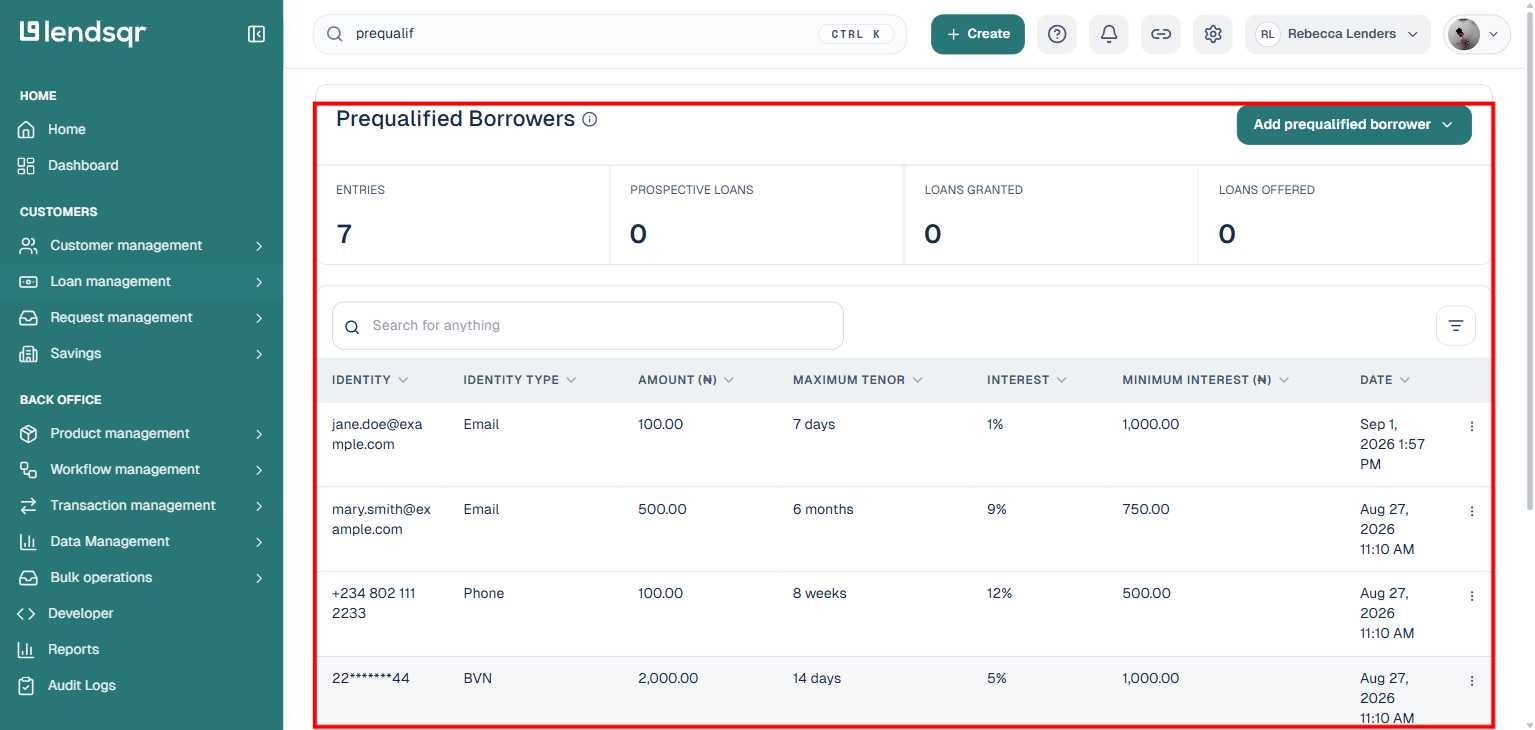
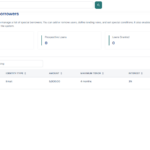
From the side navigation menu, open Loan management and select Prequalified Borrowers. This page lists every entry, with stat cards for Entries, Prospective Loans, Loans Granted, and Loans Offered at the top.
Step 2: Add the borrower and set their loan terms
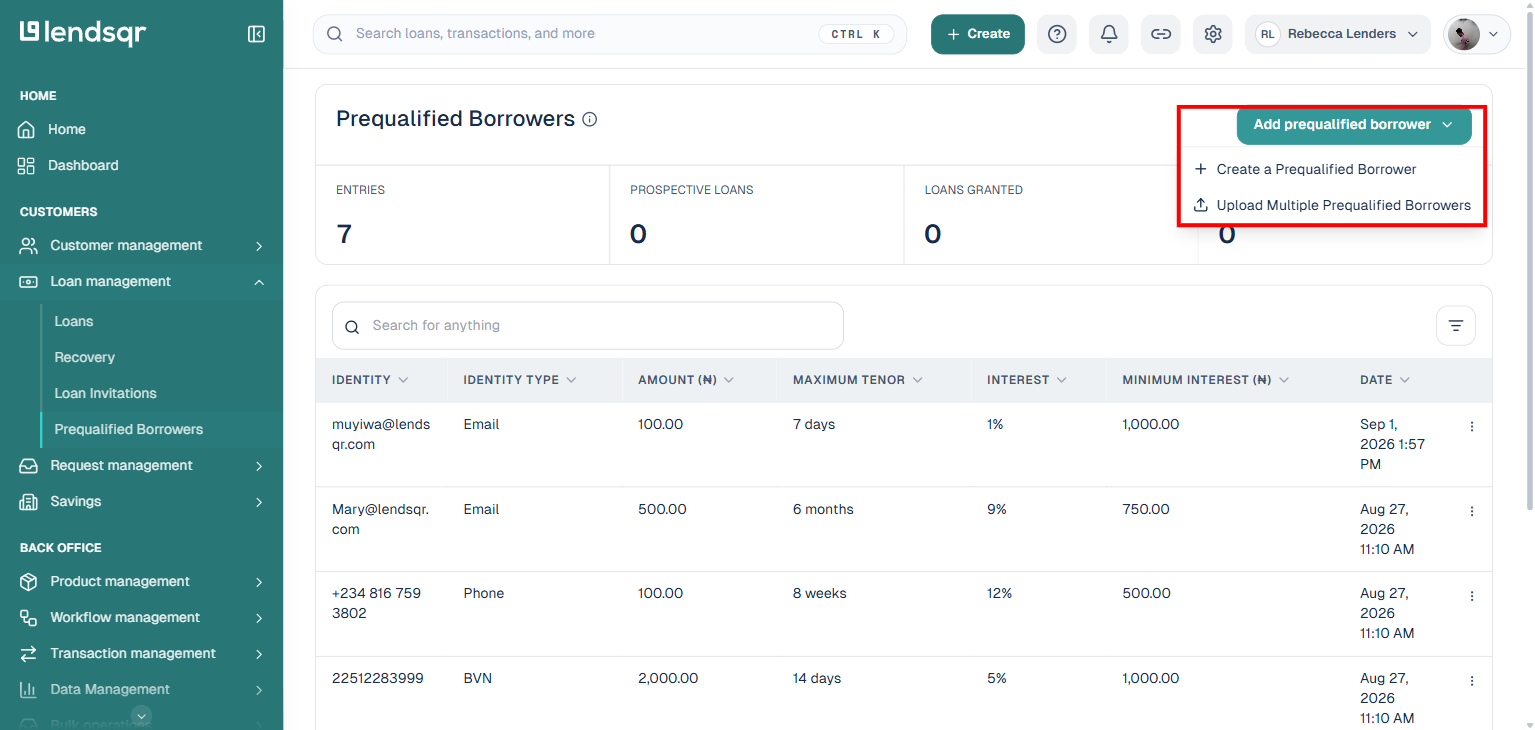
Click “Add prequalified borrower” at the top right, then choose “Create a Prequalified Borrower” for one entry or “Upload Multiple Prequalified Borrowers” for a bulk campaign.
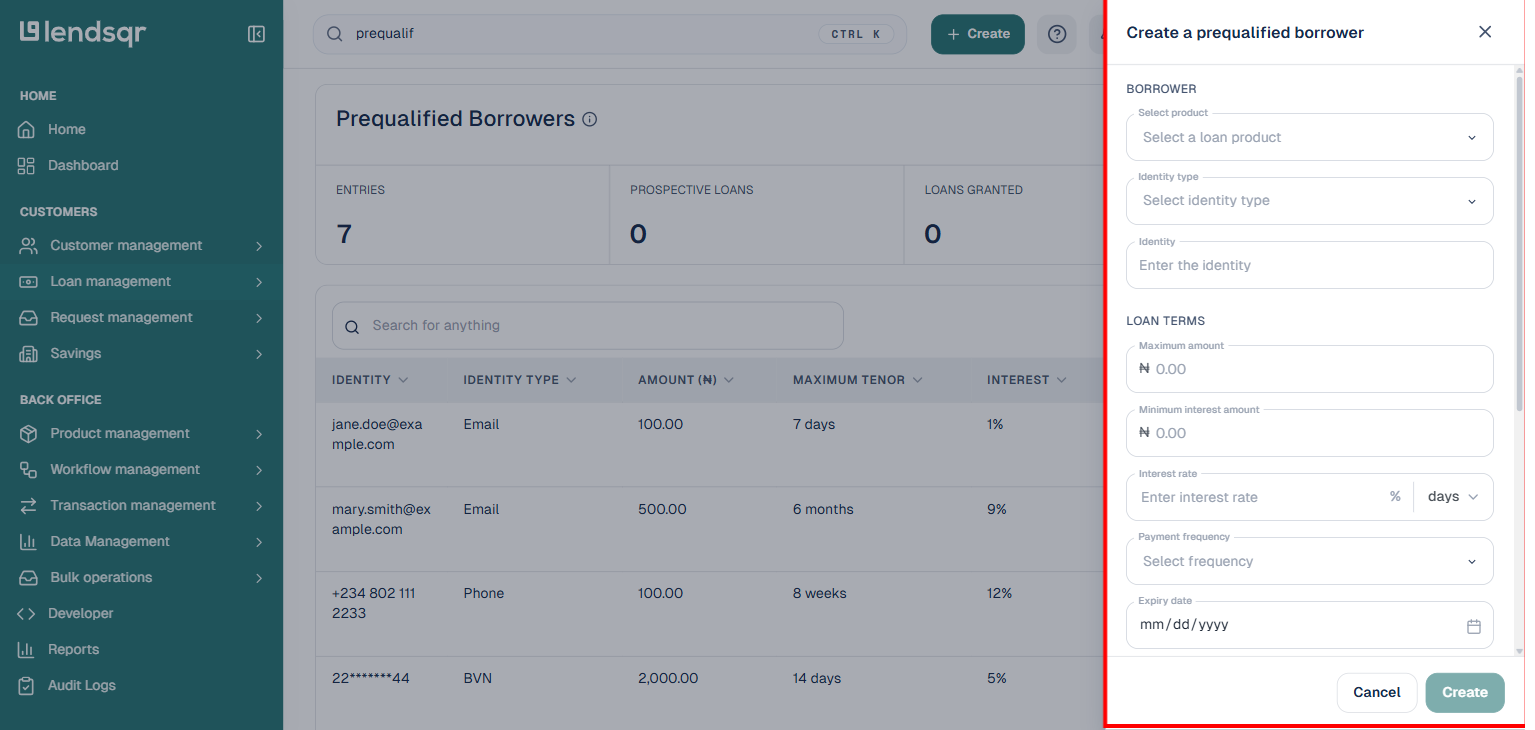
In the single-entry form, select the loan product the entry unlocks, choose an identity type (Email, Phone, or BVN) and enter the identity, then set the loan terms (maximum amount, minimum interest, interest rate, payment frequency, expiry date), tenor, and disbursement options.
Step 3: Save and activate
Click “Create” to save the entry. It is applied immediately: the customer matching that identity now sees the assigned loan product’s offer the next time they check.
How lenders prequalify customers
Lenders can prequalify customers in two primary ways, depending on operational needs and scale.
Individually
Customers can be added one at a time by entering their details directly into the Lendsqr Admin Console. These details typically include identifiers such as phone number, customer ID, or BVN.
This method is best suited for small groups of trusted borrowers or specific high-value customers who require immediate eligibility for loan products.
In bulk
Lenders can also prequalify multiple customers at once by uploading a preformatted Excel (.xlsx) file containing customer records, up to 3MB in size. A sample template is available to download from the same upload dialog.
This approach is more efficient for large-scale onboarding scenarios such as corporate partnerships, cooperatives, payroll-linked lending programs, or referral-based lending schemes.
Bulk upload ensures consistency, reduces manual effort, and allows lenders to quickly activate eligibility for large borrower groups.
To get the most value from this feature, lenders should follow structured best practices when managing prequalified groups.
First, ensure that selection criteria are clearly defined. Borrowers should only be added based on measurable performance indicators such as repayment history, account activity, or verified employment relationships.
Second, regularly review and update the prequalified list. Borrower behavior can change over time, so it is important to ensure that eligibility remains accurate and relevant.
Third, avoid overusing prequalification for too many users. The feature is most effective when used for clearly defined, low-risk segments rather than broad populations.
Finally, align prequalification rules with your overall credit risk strategy to ensure consistency across all lending decisions.
Common mistakes to avoid
One common mistake lenders make is treating prequalified borrowers as automatically risk-free. While these users are trusted, they should still be monitored for ongoing performance.
Another issue is failing to update the list regularly. Static borrower lists can quickly become outdated and may include users who no longer meet eligibility criteria.
Lenders should also avoid unclear selection rules, as this can lead to inconsistent lending decisions across teams.
Conclusion
Prequalified borrowers provide lenders with a powerful way to streamline lending operations while maintaining control over risk. By identifying trusted customers in advance, lenders can reduce friction, improve customer experience, and optimize operational efficiency.
When used correctly, this feature enables faster loan delivery for reliable borrowers while allowing lenders to focus their underwriting efforts on new or higher-risk applicants. As lending portfolios grow, prequalification becomes an essential tool for balancing speed, trust, and risk management in a scalable way.
By integrating prequalified borrowers into your lending strategy, you can create a more efficient and customer-friendly loan experience without compromising on control or credit quality.