Access your Back Office at your fingertips.
Download the app now on Google Play Store.
Scan the QR code
You can also scan QR code with your phone to download the app.
How Lendsqr protects your business and customer data
Updated
On this page
Introduction
In digital lending, trust is everything.
When customers apply for loans, they share highly sensitive information with lenders, including personal details, bank account information, identity records, and financial history. As a lender, protecting this information is not just good practice. It is a business necessity.
A single data breach, unauthorized login, or cyberattack can damage customer confidence, create regulatory problems, and expose your business to financial and reputational risk.
This is why data security has become one of the most important pillars of modern lending operations.
At Lendsqr, protecting your business and your customers is a priority. We understand that lenders need infrastructure they can trust, especially when handling sensitive financial information at scale.
To support this, Lendsqr has implemented multiple layers of protection designed to secure customer data, prevent unauthorized access, reduce fraud risks, and ensure compliance with leading data protection standards.
From bank-grade encryption to role-based permissions and two-factor authentication, our systems are designed to help lenders operate securely while maintaining customer trust.
In this guide, you will learn how Lendsqr protects customer information, the security measures built into the platform, and what lenders can do to strengthen account security even further.
Why data security matters in digital lending
Every digital lender handles highly sensitive customer information. This often includes:
Bank Verification Numbers (BVNs)
Phone numbers
Bank account details
Identity information
Credit history
Employment records
Income data
Repayment activity
Because of the sensitive nature of this information, lenders are increasingly becoming targets for:
Fraud attempts
Cyberattacks
Phishing schemes
Account hijacking
Insider abuse
Data breaches
For borrowers, trust plays a major role in deciding whether to use a lending platform.
If customers believe their personal information is unsafe, they are far less likely to complete applications or continue borrowing.
For lenders, poor security practices can lead to:
Regulatory penalties
Customer attrition
Reputation damage
Financial losses
Increased fraud exposure
Compliance violations
This is why strong security systems are no longer optional in lending. They are essential.
How Lendsqr protects customer data
At Lendsqr, customer information is treated with a high level of care and confidentiality.
Whenever borrowers submit information during onboarding or loan applications, multiple protections work behind the scenes to ensure that data remains secure.
These protections are designed to reduce vulnerabilities, restrict unauthorized access, and safeguard sensitive information throughout the lending lifecycle.
Compliance with international data protection standards
One of the most important foundations of data security is compliance.
Lendsqr follows recognized data protection frameworks to ensure customer information is collected, processed, and stored responsibly.
These frameworks establish clear standards around:
Data privacy
Consent management
Information security
Customer rights
Data handling responsibilities
For lenders, this means operating on infrastructure that aligns with internationally recognized privacy expectations. This is especially important for businesses handling regulated financial data or serving customers across different jurisdictions.
One of the biggest risks in digital lending is unauthorized access to sensitive customer data. To reduce this risk, Lendsqr encrypts customer information using bank-grade encryption protocols. Encryption helps secure data in two critical ways:
Data in transit
Whenever customer information moves between systems, such as during account sign-up or loan application, the information is encrypted while being transmitted. This helps prevent interception by malicious actors.
For example, if a borrower submits their BVN or financial details during onboarding, encryption ensures that information cannot easily be accessed during transmission.
Data at rest
Customer information is also encrypted while stored. This means that even when information is sitting inside systems or databases, it remains protected from unauthorized exposure.
Sensitive customer details such as BVNs, phone numbers, bank account information, credit records, and financial history are stored securely to minimize risks of data leakage.
For lenders, this provides additional confidence that borrower information is protected throughout the customer lifecycle.
Role-based access control for internal security
Not every employee in an organization should have access to sensitive customer information. To reduce insider risks and strengthen operational security, Lendsqr uses role-based permissions.
This means access to information is restricted based on a user’s assigned role.
For example:
Customer support teams may only see information relevant to support tasks
Operations teams may access loan servicing information
Administrators may have broader visibility depending on permissions
This approach helps reduce unnecessary exposure to sensitive borrower data. It also improves accountability because actions inside the admin console can be tied to authorized users.
For lenders managing multiple teams, role-based permissions are especially important for reducing internal security risks.
Continuous vulnerability testing and risk monitoring
Cybersecurity threats constantly evolve. Because of this, security cannot be treated as a one-time setup.
Lendsqr continuously performs vulnerability testing to identify potential weaknesses before they become larger threats.
This process helps:
Detect security risks early
Reduce exposure to cyberattacks
Improve platform resilience
Maintain operational stability
By proactively identifying vulnerabilities, issues can be resolved before they impact lenders or borrowers.
This ongoing approach helps strengthen overall platform security over time.
How two-factor authentication protects your admin console
Protecting customer data is important, but protecting lender accounts is equally critical. One compromised admin account can expose sensitive business information or create serious operational risks.
To help secure lender accounts, Lendsqr supports two-factor authentication (2FA). 2FA adds an extra layer of protection to your admin console by requiring more than just a password before login access is granted. Instead of relying solely on one credential, users must complete two separate verification steps.
These include:
Something you know
This refers to your password. It is the first layer of authentication and confirms your login credentials.
Something you have
This refers to a temporary one-time verification code sent to:
Your phone
Your email
An approved authentication method
Access is only granted after both verification steps are completed successfully.
Step-by-step guide on activating 2FA for your organization
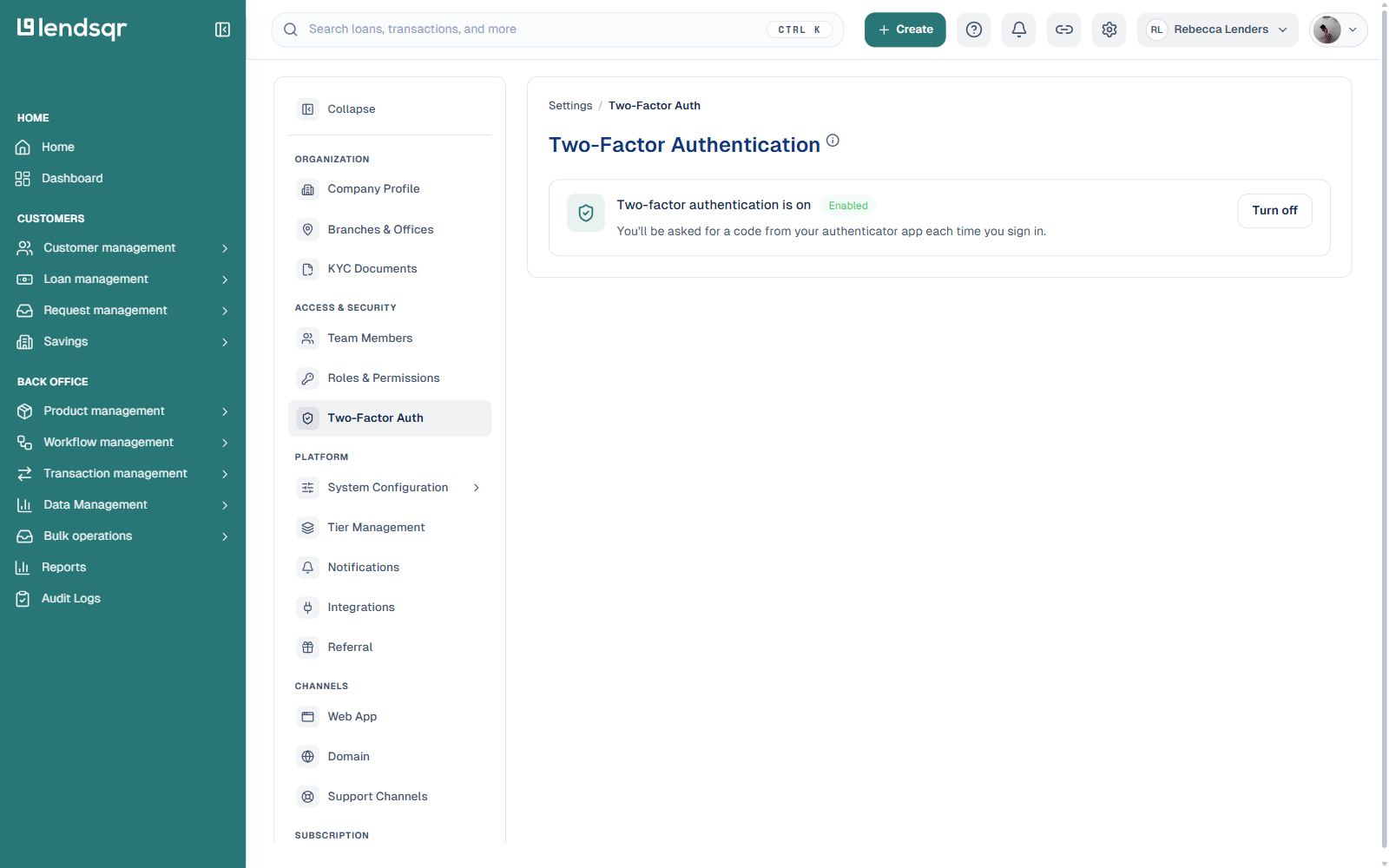
Step 1: Click the Settings icon (top right) in your admin console, then select Two-Factor Auth under the ACCESS & SECURITY section of the settings sidebar.
Step 2: The page shows whether two-factor authentication is currently on or off for your account. If it’s off, click Turn on (this button reads Turn off once 2FA is active, as in the screenshot below).
Step 3: A QR code appears. Scan it with your authenticator app (such as Google Authenticator or Authy) to link your account.
Step 4: Enter the current 6-digit code your authenticator app generates to confirm the setup. Once confirmed, two-factor authentication is active: you’ll be asked for a fresh code from your authenticator app every time you sign in.
Why two-factor authentication matters
Passwords alone are no longer enough to secure business systems. Even strong passwords may become compromised through:
Phishing attacks
Password leaks
Shared credentials
Weak password practices
Two-factor authentication significantly reduces these risks.
For example, imagine an attacker somehow obtains your password. Without access to your second authentication factor, they will still be blocked from entering your account. This extra security layer helps protect lenders against:
Unauthorized logins
Account hijacking
Insider threats
Credential theft
Phishing attacks
For businesses handling financial operations, this additional protection is highly recommended.
Real-world example of why security matters
Imagine a lending business with multiple operations staff accessing customer information daily. Without strong permissions or authentication controls, a compromised employee password could expose sensitive borrower records.
However, with:
Two-factor authentication enabled
Role-based permissions configured
Encrypted systems in place
The risk of unauthorized access becomes significantly lower. Even if login credentials are exposed, attackers would still face additional verification barriers. This layered approach is one of the reasons strong lending security requires multiple protections working together.
Relevant permissions
To manage security settings such as two-factor authentication, users may require:
Admin access
Account management permissions
Security configuration access
Super admin privileges depending on organization setup
If you cannot modify account security settings, contact your internal administrator.
Best practices
Enable two-factor authentication for all admin users
Security becomes stronger when every admin account is protected with an extra verification layer. Avoid limiting 2FA to only senior team members.
Restrict access based on job responsibilities
Only give employees access to the information necessary for their role. This helps reduce internal security risks.
Review admin permissions regularly
As teams change, review user access to ensure former employees or unnecessary roles no longer have permissions.
Educate staff on phishing risks
Many account compromises happen through phishing attempts. Train staff to avoid suspicious links, fake login pages, and unusual email requests.